

1.1 Introdução geral ao dimensionamento estrutural de detalhes de betão
O dimensionamento e a avaliação de elementos de betão são normalmente realizados ao nível seccional (elemento 1D) ou pontual (elemento 2D). Este procedimento está descrito em todas as normas de dimensionamento estrutural, por exemplo, em (EN 1992-1-1 ou ACI 318-19), e é utilizado na prática corrente de engenharia estrutural. No entanto, nem sempre é do conhecimento geral, ou respeitado, que o procedimento só é aceitável em zonas onde se aplica a hipótese de Bernoulli-Navier de distribuição plana de deformações (designadas por regiões B). As zonas onde esta hipótese não se aplica denominam-se regiões de descontinuidade ou perturbadas (regiões D). Exemplos de regiões B e D em elementos 1D são apresentados na (Fig. 1). Estas incluem, por exemplo, zonas de apoio, partes onde são aplicadas cargas concentradas, locais onde ocorre uma variação abrupta da secção transversal, aberturas, etc. No dimensionamento de estruturas de betão, encontramos muitas outras regiões D, tais como paredes, diafragmas de pontes, consolos, etc.

\[ \textsf{\textit{\footnotesize{Fig. 1\qquad Discontinuity regions (Navrátil et al. 2017)}}}\]
No passado, eram utilizadas regras de dimensionamento semi-empíricas para o dimensionamento de regiões de descontinuidade. Felizmente, estas regras foram amplamente substituídas, ao longo das últimas décadas, por modelos de escora-e-tirante (Schlaich et al., 1987) e campos de tensões (Marti 1985), que constam das normas de dimensionamento atuais e são frequentemente utilizados pelos projetistas. Estes modelos são ferramentas mecanicamente consistentes e poderosas. Note-se que os campos de tensões podem ser, em geral, contínuos ou descontínuos, e que os modelos de escora-e-tirante constituem um caso particular de campos de tensões descontínuos.
Apesar da evolução das ferramentas computacionais ao longo das últimas décadas, os modelos de Escora-e-Tirante continuam a ser essencialmente utilizados como cálculos manuais. A sua aplicação a estruturas reais é fastidiosa e morosa, uma vez que são necessárias iterações e vários casos de carga têm de ser considerados. Além disso, este método não é adequado para a verificação de critérios de estado de serviço (deformações, larguras de fendas, etc.).
O interesse dos engenheiros estruturais numa ferramenta fiável e rápida para o dimensionamento de regiões D conduziu à decisão de desenvolver o novo Método do Campo de Tensões Compatível, um método de dimensionamento de campos de tensões assistido por computador que permite o dimensionamento e a avaliação automáticos de elementos de betão estrutural sujeitos a carregamento no plano.
O Método do Campo de Tensões Compatível (CSFM) é um método de análise de campos de tensões contínuos baseado em elementos finitos, no qual as soluções clássicas de campos de tensões são complementadas com considerações cinemáticas, ou seja, o estado de deformação é avaliado em toda a estrutura. Assim, a resistência efetiva à compressão do betão pode ser calculada automaticamente com base no estado de deformação transversal, de forma semelhante às análises de campos de compressão que têm em conta o amolecimento à compressão (Vecchio e Collins 1986; Kaufmann e Marti 1998) e o método EPSF (Fernández Ruiz e Muttoni 2007). Além disso, o CSFM considera o enrijecimento à tração, conferindo rigidezes realistas aos elementos, e abrange todas as prescrições normativas (incluindo aspetos de estado de serviço e capacidade de deformação) não tratados de forma consistente pelas abordagens anteriores. O CSFM utiliza leis constitutivas uniaxiais correntes, fornecidas pelas normas de dimensionamento para o betão e a armadura. Estas são conhecidas na fase de dimensionamento, o que permite a utilização do método dos coeficientes parciais de segurança. Assim, os projetistas não têm de fornecer propriedades dos materiais adicionais, frequentemente arbitrárias, como as tipicamente exigidas para análises não lineares por elementos finitos, tornando o método perfeitamente adequado para a prática de engenharia.
Para promover a utilização de campos de tensões assistidos por computador por parte dos engenheiros estruturais, estes métodos devem ser implementados em ambientes de software de fácil utilização. Para este efeito, o CSFM foi implementado no IDEA StatiCa Detail; um novo software comercial de fácil utilização desenvolvido conjuntamente pela ETH Zurique e pela empresa de software IDEA StatiCa no âmbito do projeto DR-Design Eurostars-10571.
1.3 Ferramentas de dimensionamento de armadura
Fluxo de trabalho e objetivos
O objetivo das ferramentas de dimensionamento de armadura no CSFM é ajudar os projetistas a determinar a localização e a quantidade necessária de varões de armadura de forma eficiente. As seguintes ferramentas estão disponíveis para auxiliar/orientar o utilizador neste processo: cálculo linear e otimização topológica.
As ferramentas de dimensionamento de armadura consideram modelos constitutivos mais simplificados do que os modelos utilizados para a verificação final da estrutura. Por conseguinte, a definição da armadura nesta etapa deve ser considerada um pré-dimensionamento a confirmar/refinar durante a etapa de verificação final. A utilização das diferentes ferramentas de dimensionamento de armadura será ilustrada no modelo apresentado na Fig. 3, que consiste numa extremidade de uma viga simplesmente apoiada com altura variável sujeita a uma carga uniformemente distribuída.

\[ \textsf{\textit{\footnotesize{Fig. 3\qquad Model used to illustrate the use of the reinforcement design tools.}}}\]
Análise linear
A análise linear considera propriedades de material linearmente elásticas e despreza a armadura na região de betão. Trata-se, portanto, de um cálculo muito rápido que fornece uma primeira visão sobre as localizações das zonas de tração e compressão. Um exemplo deste cálculo é apresentado na Fig. 4.
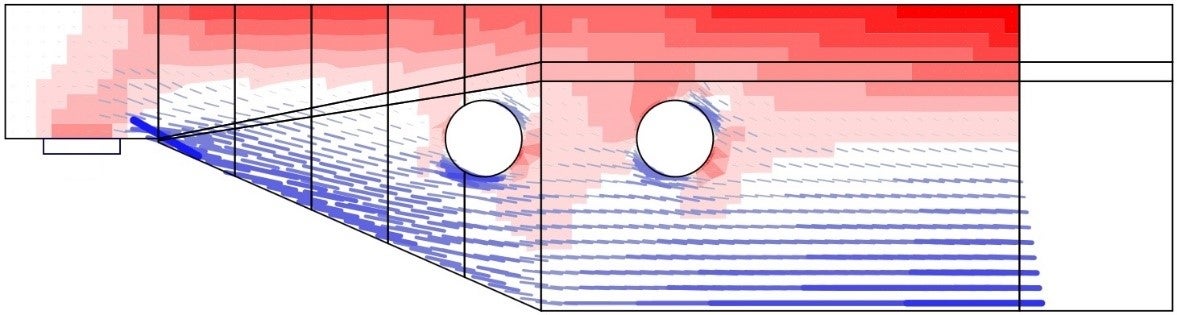
\[ \textsf{\textit{\footnotesize{Fig. 4\qquad Results from the linear analysis tool for defining reinforcement layout}}}\]
\[ \textsf{\textit{\footnotesize{(red: areas in compression, blue: areas in tension).}}}\]
Otimização topológica
A otimização topológica é um método que visa encontrar a distribuição ótima de material num dado volume para uma determinada configuração de cargas. A otimização topológica implementada no Idea StatiCa Detail utiliza um modelo de elementos finitos linear. Cada elemento finito pode ter uma densidade relativa de 0 a 100%, representando a quantidade relativa de material utilizado. Estas densidades de elemento são os parâmetros de otimização no problema de otimização. A distribuição de material resultante é considerada ótima para o conjunto de cargas dado se minimizar a energia de deformação total do sistema. Por definição, a distribuição ótima é também a geometria que apresenta a maior rigidez possível para as cargas dadas.
O processo de otimização iterativo começa com uma distribuição de densidade homogénea. O cálculo é realizado para múltiplas frações de volume total (20%, 40%, 60% e 80%), o que permite ao utilizador selecionar o resultado mais prático. A forma resultante é constituída por treliças com escoras e tirantes e representa a forma ótima para os casos de carga dados (Fig. 5).


\[ \textsf{\textit{\footnotesize{Fig. 5\qquad Results from the topology optimization design tool with 20\% and 40\% effective volume}}}\]
\[ \textsf{\textit{\footnotesize{(red: areas in compression, blue: areas in tension).}}}\]
2.1 Introdução à implementação pelo Método dos Elementos Finitos
O CSFM considera campos de tensões contínuos no betão (elementos finitos 2D), complementados por elementos discretos de "barra" que representam a armadura (elementos finitos 1D). Assim, a armadura não está difusamente incorporada nos elementos finitos 2D de betão, mas é modelada explicitamente e ligada a eles. No modelo de cálculo considera-se um estado plano de tensões.

\[ \textsf{\textit{\footnotesize{Fig. 6\qquad Visualization of the calculation model of a structural element (trimmed beam) in Idea StatiCa Detail.}}}\]
Podem ser modeladas tanto paredes e vigas completas, como detalhes (partes) de vigas (região de descontinuidade isolada, também designada por extremidade aparada). No caso de paredes e vigas completas, os apoios devem ser definidos de forma a resultar numa estrutura (externamente) isostática (estaticamente determinada) ou hiperestática (estaticamente indeterminada). A transferência de carga nas extremidades aparadas das vigas é introduzida por meio de uma zona especial de transferência de Saint-Venant, que garante uma distribuição realista de tensões na região de detalhe analisada.
3.1 Estados limite e cálculo da largura de fendas
A avaliação da estrutura utilizando o CSFM é realizada por duas análises distintas: uma para combinações de ações em estado limite de serviço e outra para estado limite último. A análise em serviço pressupõe que o comportamento último do elemento é satisfatório e que as condições de cedência do material não serão atingidas aos níveis de carga em serviço. Esta abordagem permite a utilização de modelos constitutivos simplificados (com um ramo linear do diagrama tensão-deformação do betão) para a análise em serviço, de forma a melhorar a estabilidade numérica e a velocidade de cálculo. Por isso, recomenda-se a utilização do fluxo de trabalho apresentado abaixo, no qual a análise em estado limite último é realizada como primeiro passo.
Análise em estado limite último
As diferentes verificações exigidas pelos códigos de dimensionamento específicos são avaliadas com base nos resultados diretos fornecidos pelo modelo. As verificações ULS são realizadas para a resistência do betão, resistência da armadura e ancoragem (tensões de corte de aderência).
Para garantir um dimensionamento eficiente de um elemento estrutural, recomenda-se vivamente a realização de uma análise preliminar que tenha em conta os seguintes passos:
- Selecionar as combinações de ações mais críticas.
- Calcular apenas as combinações de ações em Estado Limite Último (ULS).
- Utilizar uma malha grosseira (aumentando o multiplicador do tamanho de malha predefinido em Configurações (Fig. 19)).

\[ \textsf{\textit{\footnotesize{Fig. 19\qquad Mesh multiplier.}}}\]
Este modelo calculará muito rapidamente, permitindo aos projetistas rever a pormenorização do elemento estrutural de forma eficiente e repetir a análise até que todos os requisitos de verificação sejam satisfeitos para as combinações de ações mais críticas. Uma vez satisfeitos todos os requisitos de verificação desta análise preliminar, sugere-se que sejam incluídas as combinações de ações últimas completas e que se utilize uma malha fina (o tamanho de malha recomendado pelo programa). O utilizador pode alterar o tamanho da malha através do multiplicador, que pode assumir valores entre 0,5 e 5 (Fig. 19).
Os resultados e verificações básicos (tensão, deformação e utilização (ou seja, o valor calculado/valor limite do código), bem como a direção das tensões principais no caso de elementos de betão) são apresentados por meio de diferentes gráficos, em que a compressão é geralmente apresentada a vermelho e a tração a azul. Os valores mínimos e máximos globais para toda a estrutura podem ser destacados, bem como os valores mínimos e máximos para cada parte definida pelo utilizador. Num separador separado do programa, podem ser apresentados resultados avançados, como valores tensoriais, deformações da estrutura e taxas de armadura (efetiva e geométrica) utilizadas para calcular o enrijecimento à tração das armaduras. Além disso, podem ser apresentadas as ações e reações para combinações ou casos de carga selecionados.
Análise em estado limite de serviço
As verificações SLS são realizadas para a limitação de tensões, largura de fendas e limites de deformação. As tensões são verificadas nos elementos de betão e de armadura de acordo com o código aplicável, de forma semelhante à especificada para o ULS.
A análise em serviço contém certas simplificações dos modelos constitutivos utilizados para a análise em estado limite último. Assume-se uma aderência perfeita, ou seja, o comprimento de ancoragem não é verificado em serviço. Além disso, o ramo plástico da curva tensão-deformação do betão à compressão é desprezado, enquanto o ramo elástico é linear e infinito. Estas simplificações melhoram a estabilidade numérica e a velocidade de cálculo, e não reduzem a generalidade da solução, desde que os limites de tensão dos materiais em serviço estejam claramente abaixo dos seus pontos de cedência (conforme exigido pelas normas). Por conseguinte, os modelos simplificados utilizados em serviço só são válidos se todos os requisitos de verificação forem satisfeitos.
Cálculo da largura de fenda e enrijecimento à tração
Cálculo da largura de fenda
Existem duas formas de calcular as larguras de fenda - fissuração estabilizada e não estabilizada. De acordo com a taxa geométrica de armadura em cada parte da estrutura, é decidido qual o tipo de modelo de cálculo de fenda a utilizar (TCM para fissuração estabilizada e POM para o modelo de fissuração não estabilizada).

\( \textsf{\textit{\footnotesize{Fig. 20 \qquad Crack width calculation: (a) considered crack kinematics; (b) projection of crack kinematics into the principal}}}\) \( \textsf{\textit{\footnotesize{directions of the reinforcing bar; (c) crack width in the direction of the reinforcing bar for stabilized cracking; (d) cases with}}}\) \( \textsf{\textit{\footnotesize{local non-stabilized cracking regardless of the reinforcement amount; (e) crack width in the direction of the reinforcing bar}}}\)\( \textsf{\textit{\footnotesize{for non-stabilized cracking.}}}\)
Enquanto o CSFM fornece um resultado direto para a maioria das verificações (por exemplo, capacidade do elemento, deformações…), os resultados da largura de fenda são calculados a partir dos resultados de deformação da armadura diretamente fornecidos pela análise de elementos finitos, seguindo a metodologia descrita na Fig. 20. É considerada uma cinemática de fenda sem deslizamento (abertura pura de fenda) (Fig. 20a), o que é consistente com as principais hipóteses do modelo. As direções principais de tensões e deformações definem a inclinação das fendas (θr = θs= θe). De acordo com (Fig. 20b), a largura de fenda (w) pode ser projetada na direção da barra de armadura (wb), resultando em:
\[w = \frac{w_b}{\cos\left(θ_r + θ_b - \frac{π}{2}\right)}\]
onde θb é a inclinação da barra.
Note-se que o programa apresenta valores de θr e θb < π/2. Isto significa que a equação anterior é válida para os casos em que a armadura e a fenda atravessam quadrantes diferentes do sistema de coordenadas cartesiano, como ilustrado na Fig. 20, onde a armadura atravessa os quadrantes I e III e a fenda os quadrantes II e IV. Para os casos em que a armadura e a fenda atravessam os mesmos quadrantes, a equação deve ser modificada da seguinte forma:
\[w = \frac{w_b}{\cos\left(-θ_r + θ_b + \frac{π}{2}\right)}\]
A componente wb é calculada de forma consistente com base nos modelos de enrijecimento à tração, integrando as deformações da armadura. Para as regiões com padrões de fissuração completamente desenvolvidos, as deformações médias calculadas (em) ao longo das barras de armadura são diretamente integradas ao longo do espaçamento entre fendas (sr), conforme indicado na (Fig. 20c). Embora esta abordagem para o cálculo das direções das fendas não corresponda à posição real das fendas, fornece ainda assim valores representativos que conduzem a resultados de largura de fenda comparáveis com os valores de largura de fenda exigidos pela norma na posição da barra de armadura.
Observam-se situações especiais em cantos côncavos da estrutura calculada. Neste caso, o canto predefine a posição de uma fenda singular que se comporta de forma não estabilizada antes de se desenvolverem fendas adjacentes adicionais. Estas fendas adicionais desenvolvem-se geralmente após o intervalo de serviço (Mata-Falcón 2015), o que justifica o cálculo das larguras de fenda nessa região como se fossem não estabilizadas (Fig. 21).

\[ \textsf{\textit{\footnotesize{Fig. 21\qquad Definition of the region at concave corners in which the crack width is computed as if it were non-stabilized.}}}\]
Enrijecimento à tração
A implementação do enrijecimento à tração distingue entre casos de padrões de fissuração estabilizada e não estabilizada. Em ambos os casos, o betão é considerado completamente fendilhado antes da aplicação das cargas, por defeito.

\( \textsf{\textit{\footnotesize{Fig. 22\qquad Tension stiffening model: (a) tension chord element for stabilized cracking with distribution of bond shear,}}}\) \( \textsf{\textit{\footnotesize{steel and concrete stresses, and steel strains between cracks, considering average crack spacing); (b) pull-out assumption}}}\) \( \textsf{\textit{\footnotesize{for non-stabilized cracking with distribution of bond shear and steel stresses and strains around the crack; (c) resulting}}}\) \( \textsf{\textit{\footnotesize{tension chord behavior in terms of reinforcement stresses at the cracks and average strains for European B500B steel;}}}\) \( \textsf{\textit{\footnotesize{(d) detail of the initial branches of the tension chord response.}}}\)
Fissuração estabilizada
Em padrões de fissuração completamente desenvolvidos, o enrijecimento à tração é introduzido utilizando o Modelo de Corda em Tração (TCM) (Marti et al. 1998; Alvarez 1998) – Fig. 22a – que demonstrou fornecer excelentes previsões de resposta apesar da sua simplicidade (Burns 2012). O TCM assume uma relação tensão de aderência-deslizamento rígida-perfeitamente plástica em degrau com τb = τb0 =2 fctm para σs ≤ fy e τb =τb1 = fctm para σs > fy. Tratando cada barra de armadura como uma corda em tração – Fig. 22b e Fig. 22a – a distribuição das tensões de aderência, do aço e do betão e, consequentemente, a distribuição de deformações entre duas fendas pode ser determinada para qualquer valor dado das tensões máximas do aço (ou deformações) nas fendas.
Para sr = sr0, uma nova fenda pode ou não formar-se porque no centro entre duas fendas σc1 = fct. Consequentemente, o espaçamento entre fendas pode variar por um fator de dois, ou seja, sr = λsr0, com l = 0,5…1,0. Assumindo um determinado valor para λ, a deformação média da corda (εm) pode ser expressa em função das tensões máximas da armadura (ou seja, tensões nas fendas, σsr). Para o diagrama tensão-deformação bilinear idealizado para as barras de armadura nuas considerado por defeito no CSFM, obtêm-se as seguintes expressões analíticas de forma fechada (Marti et al. 1998):
\[\varepsilon_m = \frac{\sigma_{sr}}{E_s} - \frac{\tau_{b0}s_r}{E_s Ø}\]
\[\textrm{for}\qquad\qquad\sigma_{sr} \le f_y\]
\[{\varepsilon_m} = \frac{{{{\left( {{\sigma_{sr}} - {f_y}} \right)}^2}Ø}}{{4{E_{sh}}{\tau _{b1}}{s_r}}}\left( {1 - \frac{{{E_{sh}}{\tau_{b0}}}}{{{E_s}{\tau_{b1}}}}} \right) + \frac{{\left( {{\sigma_{sr}} - {f_y}} \right)}}{{{E_s}}}\frac{{{\tau_{b0}}}}{{{\tau_{b1}}}} + \left( {{\varepsilon_y} - \frac{{{\tau_{b0}}{s_r}}}{{{E_s}Ø}}} \right)\]
\[\textrm{for}\qquad\qquad{f_y} \le {\sigma _{sr}} \le \left( {{f_y} + \frac{{2{\tau _{b1}}{s_r}}}{Ø}} \right)\]
\[ \varepsilon_m = \frac{f_s}{E_s} + \frac{\sigma_{sr}-f_y}{E_{sh}} - \frac{\tau_{b1} s_r}{E_{sh} Ø}\]
\[\textrm{for}\qquad\qquad\left(f_y + \frac{2\tau_{b1}s_r}{Ø}\right) \le \sigma_{sr} \le f_t\]
onde:
Esh o módulo de endurecimento do aço Esh = (ft – fy)/(εu – fy /Es) ,
Es módulo de elasticidade da armadura,
Ø diâmetro da barra de armadura,
sr espaçamento entre fendas,
σsr tensões da armadura nas fendas,
σs tensões reais da armadura,
fy tensão de cedência da armadura.
A implementação do CSFM no IDEA StatiCa Detail considera o espaçamento médio entre fendas por defeito ao realizar a análise de campos de tensões assistida por computador. O espaçamento médio entre fendas é considerado como 2/3 do espaçamento máximo entre fendas (λ = 0,67), o que segue as recomendações feitas com base em ensaios de flexão e tração (Broms 1965; Beeby 1979; Meier 1983). Deve notar-se que os cálculos das larguras de fenda consideram um espaçamento máximo entre fendas (λ = 1,0) de forma a obter valores conservadores.
A aplicação do TCM depende da taxa de armadura e, portanto, a atribuição de uma área de betão adequada a atuar em tração entre as fendas a cada barra de armadura é crucial. Foi desenvolvido um procedimento numérico automático para definir a taxa de armadura efetiva correspondente (ρeff = As/Ac,eff) para qualquer configuração, incluindo armadura inclinada (Fig. 23).

\( \textsf{\textit{\footnotesize{Fig. 23\qquad Effective area of concrete in tension for stabilized cracking: (a) maximum concrete area that can be activated;}}}\) \( \textsf{\textit{\footnotesize{(b) cover and global symmetry condition; (c) resultant effective area.}}}\)
Fissuração não estabilizada
As fendas existentes em regiões com taxas geométricas de armadura inferiores a ρcr, ou seja, a quantidade mínima de armadura para a qual a armadura é capaz de suportar a carga de fissuração sem ceder, são geradas por ações não mecânicas (por exemplo, retração) ou pela progressão de fendas controladas por outra armadura. O valor desta armadura mínima é obtido da seguinte forma:
\[{\rho _{cr}} = \frac{{{f_{ct}}}}{{{f_y} - \left( {n - 1} \right){f_{ct}}}}\]
onde:
fy tensão de cedência da armadura,
fct resistência à tração do betão,
n razão modular, n = Es / Ec .
Para betão e aço de armadura convencionais, ρcr é aproximadamente 0,6%.
Para estribos com taxas de armadura inferiores a ρcr, a fissuração é considerada não estabilizada e o enrijecimento à tração é implementado por meio do Modelo de Arrancamento (POM) descrito na Fig. 22b. Este modelo analisa o comportamento de uma fenda singular considerando ausência de interação mecânica entre fendas separadas, desprezando a deformabilidade do betão à tração e assumindo a mesma relação tensão de aderência-deslizamento rígida-perfeitamente plástica em degrau utilizada pelo TCM. Isto permite obter a distribuição de deformações da armadura (εs) na vizinhança da fenda para qualquer tensão máxima do aço na fenda (σsr) diretamente a partir do equilíbrio. Dado que o espaçamento entre fendas é desconhecido para um padrão de fissuração não completamente desenvolvido, a deformação média (εm) é calculada para qualquer nível de carga ao longo da distância entre pontos com deslizamento nulo quando a barra de armadura atinge a sua resistência à tração (ft) na fenda (lε,avg na Fig. 22b), conduzindo às seguintes relações:

Os modelos propostos permitem o cálculo do comportamento da armadura aderente, que é finalmente considerado na análise. Este comportamento (incluindo o enrijecimento à tração) para o aço de armadura europeu mais comum (B500B, com ft / fy = 1,08 e εu = 5%) é ilustrado nas Fig. 22c-d.
Verificações de elementos estruturais de acordo com o Eurocódigo
A avaliação da estrutura utilizando o CSFM é realizada por duas análises distintas: uma para as combinações de ações em estado limite de serviço e outra para as combinações de ações em ULS. A análise de SLS pressupõe que o comportamento último do elemento é satisfatório e que as condições de cedência do material não serão atingidas aos níveis de carga de serviço. Esta abordagem permite a utilização de modelos constitutivos simplificados (com um ramo linear do diagrama tensão-deformação do betão) na análise de SLS, de forma a melhorar a estabilidade numérica e a velocidade de cálculo.
References
ACI Committee 318. 2009a. Building Code Requirements for Structural Concrete (ACI 318-08) and Commentary. Farmington Hills, MI: American Concrete Institute.
Alvarez, Manuel. 1998. Einfluss des Verbundverhaltens auf das Verformungsvermögen von Stahlbeton. IBK Bericht 236. Basel: Institut für Baustatik und Konstruktion, ETH Zurich, Birkhäuser Verlag.
Beeby, A. W. 1979. “The Prediction of Crack Widths in Hardened Concrete.” The Structural Engineer 57A (1): 9–17.
Broms, Bengt B. 1965. “Crack Width and Crack Spacing In Reinforced Concrete Members.” ACI Journal Proceedings 62 (10): 1237–56. https://doi.org/10.14359/7742.
Burns, C.. 2012. “Serviceability Analysis of Reinforced Concrete Members Based on the Tension Chord Model.” IBK Report Nr. 342, Zurich, Switzerland: ETH Zurich.
Crisfield, M. A. 1997. Non-Linear Finite Element Analysis of Solids and Structures. Wiley.
European Committee for Standardization (CEN). 2015. 1 Eurocode 2: Design of concrete structures - Part 1-1: General rules and rules for buildings. Brussels: CEN, 2005.
Fernández Ruiz, M., and A. Muttoni. 2007. “On Development of Suitable Stress Fields for Structural Concrete.” ACI Structural Journal 104 (4): 495–502.
Kaufmann, W., J. Mata-Falcón, M. Weber, T. Galkovski, D. Thong Tran, J. Kabelac, M. Konecny, J. Navratil, M. Cihal, and P. Komarkova. 2020. “Compatible Stress Field Design Of Structural Concrete. Berlin, Germany.”AZ Druck und Datentechnik GmbH, ISBN 978-3-906916-95-8.
Kaufmann, W., and P. Marti. 1998. “Structural Concrete: Cracked Membrane Model.” Journal of Structural Engineering 124 (12): 1467–75. https://doi.org/10.1061/(ASCE)0733-9445(1998)124:12(1467).
Kaufmann, W.. 1998. “Strength and Deformations of Structural Concrete Subjected to In-Plane Shear and Normal Forces.” Doctoral dissertation, Basel: Institut für Baustatik und Konstruktion, ETH Zürich. https://doi.org/10.1007/978-3-0348-7612-4.
Konečný, M., J. Kabeláč, and J. Navrátil. 2017. Use of Topology Optimization in Concrete Reinforcement Design. 24. Czech Concrete Days (2017). ČBS ČSSI. https://resources.ideastatica.com/Content/06_Detail/Verification/Articles/Topology_optimization_US.pdf.
Marti, P. 1985. “Truss Models in Detailing.” Concrete International 7 (12): 66–73.
Marti, P. 2013. Theory of Structures: Fundamentals, Framed Structures, Plates and Shells. First edition. Berlin, Germany: Wiley Ernst & Sohn.
http://sfx.ethz.ch/sfx_locater?sid=ALEPH:EBI01&genre=book&isbn=9783433029916.
Marti, P., M.Alvarez, W. Kaufmann, and V. Sigrist. 1998. “Tension Chord Model for Structural Concrete.” Structural Engineering International 8 (4): 287–298.
https://doi.org/10.2749/101686698780488875.
Mata-Falcón, J. 2015. “Serviceability and Ultimate Behaviour of Dapped-End Beams (In Spanish: Estudio Del Comportamiento En Servicio y Rotura de Los Apoyos a Media Madera).” PhD thesis, Valencia: Universitat Politècnica de València.
Meier, H. 1983. “Berücksichtigung Des Wirklichkeitsnahen Werkstoffverhaltens Beim Standsicherheitsnachweis Turmartiger Stahlbetonbauwerke.” Institut für Massivbau, Universität Stuttgart.
Navrátil, J., P. Ševčík, L. Michalčík, P. Foltyn, and J. Kabeláč. 2017. A Solution for Walls and Details of Concrete Structures. 24. Czech Concrete Days.
Schlaich, J., K. Schäfer, and M. Jennewein. 1987a. “Toward a Consistent Design of Structural Concrete.” PCI Journal 32 (3): 74–150.
Vecchio, F.J., and M.P. Collins. 1986. “The Modified Compression Field Theory for Reinforced Concrete Elements Subjected to Shear.” ACI Journal 83 (2): 219–31.