


IDEA StatiCa Detail – Calcul structurel des discontinuités 3D en béton
Calcul structurel des discontinuités 3D en béton dans IDEA StatiCa Detail
1 Introduction à la méthode CSFM 3D
1.1 Introduction générale au calcul structurel des détails 3D en béton
1.2 Hypothèses principales et limitations
1.3 Implémentation de la théorie de plasticité de Mohr-Coulomb dans le CSFM 3D
1.4 Hypothèses mécaniques générales pour le CSFM 3D
2 Modèle d'analyse d'IDEA StatiCa 3D Detail
2.1 Introduction à l'implémentation par éléments finis
2.2 Types généraux d'éléments finis
2.3 Dispositifs de transfert de charge
2.4 Maillage dans le CSFM 3D
2.5 Méthode de résolution et algorithme de contrôle de charge pour le CSFM 3D
2.6 Présentation des résultats 3D
2.7 Modèle importé depuis IDEA StatiCa Connection
3 Vérification du modèle
4 Vérifications structurelles selon l'EUROCODE
4.1 Modèles de matériaux dans le CSFM 3D (EN)
4.2 Coefficients partiels de sécurité
4.3 Vérifications à l'état limite ultime
5 Vérifications structurelles selon ACI 318-19
5.1 Modèles de matériaux dans le CSFM 3D (ACI)
5.2 Coefficients de réduction de résistance et coefficients de charge
5.3 Vérifications de résistance
6 Vérifications structurelles selon AASHTO
6.1 Modèles de matériaux dans le CSFM 3D (AASHTO)
6.2 Coefficients de résistance et coefficients de charge
6.3 Vérifications à l'état limite de résistance
7 Vérifications structurelles selon AS 3600
7.1 Modèles de matériaux dans le CSFM 3D (AUS)
7.2 Coefficients de réduction de contrainte et de résistance, et coefficients de charge
7.3 Vérifications de résistance et d'ancrage
1 Introduction à la méthode CSFM 3D
1.1 Introduction générale à la conception structurelle des détails 3D en béton
En pratique, les ingénieurs peuvent rencontrer différents types d'éléments finis (des simples éléments barres 1D aux éléments briques 3D plus complexes) utilisés dans diverses applications pour l'analyse et la conception d'éléments structurels. Une caractéristique commune à la plupart des calculs en pratique est le comportement linéaire des modèles, dont les avantages sont indéniablement la rapidité, la clarté, et simplement le fait que pour une grande variété de problèmes, cette solution est tout à fait suffisante.
En particulier dans le domaine des structures en béton, il arrive souvent que l'approche linéaire ne soit pas suffisante, simplement parce qu'après l'apparition des premières fissures dans l'élément chargé, les contraintes se redistribuent et le problème devient significativement non linéaire.
Pour ces cas, il est nécessaire de choisir l'une des approches plus sophistiquées. Pour les cas 1D, des méthodes analytiques définies directement dans les normes peuvent souvent être trouvées. Par exemple, des modèles Bielle et tirant populaires peuvent être construits pour des éléments plans 2D et des régions de discontinuité (régions D), ou la méthode du champ de contraintes plus sophistiquée implémentée dans IDEA StatiCa Detail, le CSFM, peut être utilisée.
Cependant, si l'ingénieur rencontre un problème qui ne peut pas être simplifié en comportement plan, les options sont très limitées. Bien sûr, un modèle Bielle-et-tirant 3D peut être construit ou un logiciel semi-scientifique peut être utilisé pour une analyse précise. Ces procédures sont souvent chronophages, non conformes aux normes et nécessitent un ingénieur compétent dans les méthodes de modélisation avancées.
Pour cette raison, IDEA StatiCa a développé et implémenté le CSFM 3D (Méthode du Champ de Contraintes Compatible) dans l'application Detail. Le CSFM 3D étend le CSFM établi dans une troisième dimension, offrant une solution rapide et conforme aux normes qui s'applique principalement à l'ingénieur structure du quotidien, lui donnant une nouvelle capacité unique pour traiter en toute sécurité les détails complexes des structures en béton.
1.2 Principales hypothèses et limitations du CSFM en 3D
Le CSFM 3D définit le comportement du béton sur la base de la théorie de plasticité de Mohr-Coulomb modifiée pour les chargements monotones. La méthode prend en compte les contraintes principales du béton en compression et les contraintes du ferraillage (σsr) aux fissures, tout en négligeant la résistance à la traction du béton (coupure en traction), à l'exception de son effet de raidissement sur le ferraillage (Raidissement en traction).
σc1r, σc2r, σc3r ≤ 0 MPa
Les barres de ferraillage sont liées aux éléments finis volumiques de béton par des éléments d'adhérence, permettant un glissement entre le béton et le ferraillage. Il convient de noter que le CSFM 3D n'est pas adapté à la simulation du béton non armé en raison de l'absence de traction, ce qui peut entraîner des déformations trompeuses et une divergence du modèle. En général, la théorie de Mohr-Coulomb comprend deux propriétés fondamentales régissant l'évolution de la surface de plasticité en compression et partiellement en traction : l'angle de frottement interne φ et le paramètre de cohésion c. Le CSFM 3D suppose un angle de frottement interne nul (Fig. 1e), conduisant à un dimensionnement conservateur car la surface de plasticité ressemble au modèle de Tresca, qui est indépendant du premier invariant de contrainte.

\( \textsf{\textit{\footnotesize{Fig. 1\qquad Basic assumptions of the 3D CSFM: (a) principal stresses in concrete; (b) stresses in the reinforcement direction;}}}\) \( \textsf{\textit{\footnotesize{(c) stress-strain diagram of concrete in terms of maximum stresses; (d) stress-strain diagram of reinforcement}}}\) \( \textsf{\textit{\footnotesize{in terms of stresses at cracks and average strains; (e) Mohr's circles for concrete model in 3D CSFM; (f) bond shear stress-slip}}}\) \( \textsf{\textit{\footnotesize{relationship for anchorage length verifications.}}}\)
Béton
Le modèle de matériau présenté est un modèle de plasticité à surfaces multiples résultant de la combinaison des modèles de Mohr-Coulomb et de Rankine pour les chargements monotones. Il est important de noter que ce modèle ne traite pas le déchargement ; par conséquent, les variables d'état ne sont pas stockées, contrairement aux modèles de plasticité classiques utilisés pour les chargements cycliques.

\[ \textsf{\textit{\footnotesize{Fig. 2\qquad Mohr-Coulomb multi-surface plasticity model for friction angle 0 degree}}}\]
Comme mentionné précédemment, le modèle de matériau est destiné à être utilisé dans des applications calculant la réponse du béton armé (non adapté au béton non armé). Cela est dû à l'exclusion du béton en traction. Par conséquent, le modèle n'est pas non plus adapté aux éléments structurels pour lesquels les règles de dimensionnement du béton armé, telles que le taux de ferraillage minimal, l'espacement maximal des barres, etc., ne sont pas respectées. Il convient également d'ajouter que, pour des raisons de stabilité numérique, une très faible capacité en traction est définie dans le modèle. La partie en traction est limitée par des plans correspondant au modèle de Rankine.
Le CSFM 3D dans IDEA StatiCa Detail ne prend pas en compte de critère de rupture explicite en termes de déformations pour le béton en compression (c'est-à-dire qu'il considère une branche plastique infinie après l'atteinte de la contrainte maximale). Cette simplification ne permet pas de vérifier la capacité de déformation des structures dont la rupture se produit en compression. Cependant, leur capacité ultime est correctement prédite lorsque l'augmentation de la fragilité du béton avec sa résistance est prise en compte au moyen du facteur de réduction 𝜂𝑓𝑐 défini dans le fib Model Code 2010 comme suit :
\[f_{c,red} = \eta _{fc} \cdot f_{c}\]
\[{\eta _{fc}} = {\left( {\frac{{30}}{{{f_{c}}}}} \right)^{\frac{1}{3}}} \le 1\]
où :
fc est la résistance caractéristique sur cylindre du béton (en MPa pour la définition de \( \eta_{fc} \)).
La valeur fc,red est ensuite comparée à la contrainte principale équivalente σc,eq dans le béton, qui sera définie ultérieurement, en tenant bien entendu compte de tous les coefficients de sécurité prescrits par la norme.
Une description détaillée du modèle de béton est disponible au lien suivant :
Ferraillage
Le diagramme contrainte-déformation bilinéaire pour les barres de ferraillage, tel que défini par les normes de dimensionnement (Fig. 1d), représente un modèle idéalisé. Ce modèle nécessite la connaissance des propriétés de base du ferraillage lors de la phase de dimensionnement, notamment la résistance et la classe de ductilité. Les utilisateurs ont également la possibilité de définir une relation contrainte-déformation personnalisée.
Le raidissement en traction est pris en compte en modifiant la relation contrainte-déformation de la barre de ferraillage nue afin de capturer la rigidité moyenne des barres noyées dans le béton (εm) (Fig. 1b).
Ancrage
Le glissement entre le ferraillage et le béton est introduit dans le modèle éléments finis en considérant la relation constitutive simplifiée rigide-parfaitement plastique présentée en (Fig. 1f), où fbd est la valeur de calcul (valeur pondérée) de la contrainte d'adhérence ultime spécifiée par la norme de dimensionnement pour les conditions d'adhérence spécifiques.
Il s'agit d'un modèle simplifié dont le seul objectif est de vérifier les prescriptions d'adhérence conformément aux normes de dimensionnement (c'est-à-dire l'ancrage du ferraillage). La réduction de la longueur d'ancrage lors de l'utilisation de crochets, de boucles et de formes de barres similaires peut être prise en compte en définissant une certaine capacité à l'extrémité du ferraillage, comme décrit ultérieurement.
Ancrages
L'élément d'ancrage est défini comme étant capable de transmettre des efforts normaux de traction ou de compression, ainsi que des efforts de cisaillement, en tenant compte de la rigidité en flexion.
Les types d'ancrages suivants sont disponibles :
- Ancrages coulés en place
- Ferraillage
- Rondelle
- Goujon à tête
- Ferraillage coulé en place
- Ferraillage
- Tiges filetées
Coulé en place - Ferraillage
Modélisé comme un ferraillage nervuré noyé dans le béton. La résistance d'adhérence est calculée conformément aux règles de la norme sélectionnée, de la même manière que pour le ferraillage standard. À l'extrémité de l'ancrage, un type d'ancrage peut être défini, fonctionnant de manière identique au ferraillage — un ressort d'ancrage est appliqué avec le facteur β défini selon la norme choisie. Trois formes géométriques sont disponibles : Droite, Forme en L, Forme en U.

\[ \textsf{\textit{\footnotesize{Fig. 3\qquad Cast-in reinforcement anchor - shapes}}}\]
Coulé en place - Rondelle et goujon à tête
La rondelle et la tête du goujon à tête sont modélisées comme un élément plaque-coque du matériau correspondant, fixé directement au fût de l'ancrage. Elle transfère la charge au béton par contact en compression uniquement. Formes disponibles : circulaire et carrée (uniquement circulaire pour le goujon à tête), avec des dimensions personnalisables. Le modèle de rondelle et de tête est élastique et n'est pas vérifié en résistance.
Au niveau du modèle éléments finis, l'arrachement de l'ancrage est directement vérifié. Le contact en compression est assorti de critères d'arrêt de sorte qu'il ne peut pas transmettre au béton une contrainte de contact supérieure à celle prescrite par la norme sélectionnée. En pratique, cela signifie que si l'ancrage devait être chargé par une force non conforme à la vérification de l'arrachement, le résultat serait une interruption prématurée du calcul, car ce critère d'arrêt serait dépassé lors du chargement ultérieur.
Le fût de l'ancrage présente une résistance d'adhérence nulle — toute la charge est transmise au béton par la plaque ou la tête.
Post-installés - Ferraillage et tige filetée
Conçus comme des barres installées dans des trous forés et scellées avec un adhésif. L'ingénieur spécifie la résistance d'adhérence de calcul directement à partir de la spécification technique du produit adhésif.
De plus amples informations sur la connexion des différents types d'ancrages à la platine de base ou à la platine noyée sont disponibles dans le chapitre Types d'éléments finis - Dispositifs de transfert de charge.
1.3 Mise en œuvre de la théorie de plasticité de Mohr-Coulomb dans le CSFM 3D
Dans le chapitre suivant, nous examinerons comment la théorie de Mohr-Coulomb est mise en œuvre dans le CSFM 3D. Nous expliquerons comment l'effet de confinement (contrainte triaxiale) est pris en compte et comment la contrainte principale équivalente σc,eq est calculée, utilisée pour déterminer la capacité portante du point de vue du béton.
Introduction à la théorie
La théorie de Mohr-Coulomb est un modèle mathématique décrivant la réponse des matériaux fragiles au cisaillement et à la contrainte normale. La plupart des matériaux d'ingénierie classiques suivent cette règle dans au moins une partie de leur enveloppe de rupture par cisaillement. En général, la théorie s'applique aux matériaux pour lesquels la résistance à la compression dépasse largement la résistance à la traction.
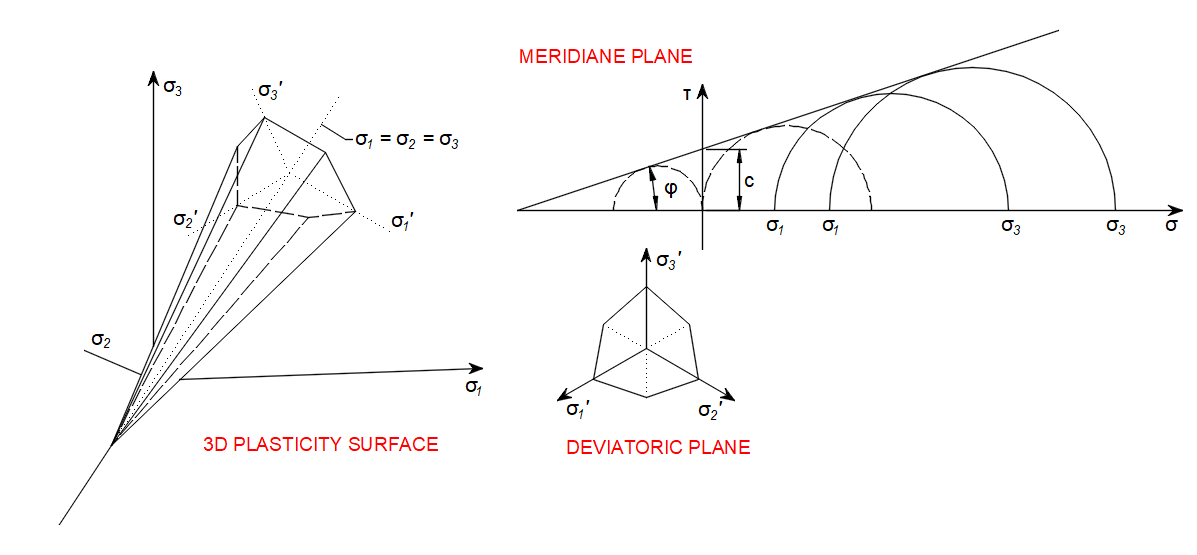
\[ \textsf{\textit{\footnotesize{Fig. 4\qquad Mohr-Coulomb Plasticity Model }}}\]
En ingénierie structurelle, elle est utilisée pour déterminer la charge de rupture ainsi que l'angle de fracture pour le déplacement de la surface de rupture dans le béton et les matériaux similaires. L'hypothèse de frottement de Coulomb est utilisée pour déterminer la combinaison de cisaillement et de contrainte normale qui provoquera la rupture du matériau. Le cercle de Mohr est utilisé pour déterminer quelles contraintes principales produiront cette combinaison de cisaillement et de contrainte normale, ainsi que l'angle du plan dans lequel cela se produira. Selon le principe de normalité, la contrainte introduite à la rupture sera perpendiculaire à la ligne décrivant la condition de rupture.

\[ \textsf{\textit{\footnotesize{Fig. 5\qquad Meridian plane and tension cut-off}}}\]
Il peut être démontré qu'un matériau se rompant selon l'hypothèse de frottement de Coulomb présentera un déplacement introduit à la rupture formant un angle avec la ligne de fracture égal à l'angle de frottement. Cela rend la résistance du matériau déterminable en comparant le travail mécanique externe introduit par le déplacement et la charge externe avec le travail mécanique interne introduit par la déformation et la contrainte à la ligne de rupture. Par conservation de l'énergie, la somme de ces termes doit être nulle, ce qui permettra de calculer la charge de rupture de la construction.
Mise en œuvre dans le CSFM 3D
En général, pour un angle de frottement interne du béton donné, qui est d'environ φ = 30-40° dans les références [1], [2], [3], [4], les cercles de Mohr des résistances à la traction et à la compression du béton peuvent être construits comme à la Figure 6.

\[ \textsf{\textit{\footnotesize{Fig. 6\qquad Mohr's circles for concrete}}}\]
Où fc est la résistance du béton en compression, fct est la résistance du béton en traction, φ est l'angle de frottement interne, et σc1, σc3 sont les contraintes principales du béton sous compression triaxiale.
On peut remarquer que lorsque la contrainte principale σc3 augmente, la différence maximale possible entre les valeurs de σc3 et σc1, que nous définissons comme σc,eq maximal (voir ci-dessous), augmente également. Cette différence correspond au double de la contrainte déviatorique définie dans la littérature comme le rayon des cercles de Mohr.
Dans le CSFM 3D mis en œuvre dans IDEA StatiCa Detail, l'angle de frottement interne est considéré comme φ = 0°, comme illustré à la Figure 7.

\[ \textsf{\textit{\footnotesize{Fig. 7\qquad Mohr's circles for concrete implemented in IDEA StatiCa Detail}}}\]
La conséquence pratique de cette mise en œuvre est que la différence maximale entre σc3 et σc1 est constante lorsque σc3 augmente.
La contrainte principale équivalente exprime la contrainte uniaxiale équivalente pour un état de contrainte triaxial général.
\[\sigma_{c,eq} = \sigma_{c3} - \sigma_{c1}\]
La valeur σc,eq peut donc être directement comparée aux limites de résistance uniaxiale selon les normes.
\[\frac{\sigma_{c,eq} }{ \sigma_{c,lim}} \le 1\]
Où σc,lim est la résistance uniaxiale de calcul (factorisée) du béton fc.
En comparant la Figure 6, où l'angle de frottement interne réel est utilisé, et la Figure 7, qui montre la mise en œuvre de la théorie de Mohr-Coulomb avec un angle de frottement interne nul, on peut constater que l'approche choisie pour les calculs dans Detail est très conservative pour l'évaluation de l'état de contrainte triaxial.
Pour une meilleure compréhension des zones affectées par la contrainte de compression triaxiale, l'expression de l'augmentation de la résistance effective du matériau due à la compression triaxiale a été ajoutée à l'application IDEA StatiCa Detail sous la forme du rapport σc3/σc,lim. Ce rapport est disponible dans la vérification normative de résistance.
Dans les résultats auxiliaires, l'utilisateur peut également trouver le facteur κ, qui explique la triaxialité d'une manière différente.
\[\kappa = \frac{ \sigma_{c3}}{ \sigma_{c,eq}}\]
La vérification de la résistance du béton peut alors être réécrite comme suit :
\[\frac{\sigma_{c,eq} }{ \sigma_{c,lim}} = \frac{\sigma_{c,3} }{ \kappa \cdot \sigma_{c,lim}} \le 1\]
Il découle de ce qui précède que si l'élément est soumis à une contrainte hydrostatique — σc3=σc2=σc1, la contrainte principale équivalente σc,eq aura une valeur nulle, et le facteur kappa tendra vers l'infini.
Pour en savoir plus : Contrainte triaxiale – l'effet de confinement actif
1.4 Hypothèses générales de mécanique pour le CSFM 3D
Équations d'équilibre
La théorie des petites déformations permet d'assembler l'équation d'équilibre sur le volume non déformé en utilisant une approche au premier ordre.

\[ \textsf{\textit{\footnotesize{Fig. 8\qquad Equilibrium equations and graphical representation on infinitesimal element}}}\]
Équations de compatibilité
Un corps solide est composé de volumes infinitésimaux ou de points matériels, chacun étant interconnecté sans lacunes ni chevauchements. Des conditions mathématiques doivent être respectées afin d'éviter l'apparition de lacunes ou de chevauchements lorsqu'un corps continu se déforme.
Équations constitutives
Les équations constitutives régissant le comportement des éléments 3D jouent un rôle central dans l'analyse du comportement des matériaux en mécanique des structures. Ces équations sont formulées pour prendre en compte le comportement isotrope non linéaire, qui est valable pour les éléments de type bloc solide dans IDEA StatiCa Detail.
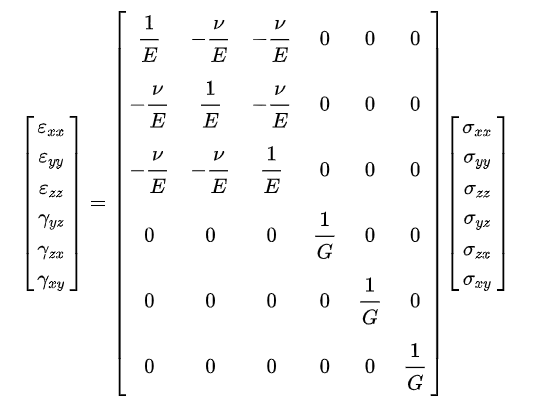
\[ \textsf{\textit{\footnotesize{Fig. 9\qquad Linearly elastic isotropic compliance matrix}}}\]
2 Modèle d'analyse d'IDEA StatiCa 3D Detail
2.1 Introduction à la mise en œuvre de la Méthode des Éléments Finis
Le CSFM 3D considère des champs de contraintes continus dans le béton (éléments finis 3D), complétés par des éléments discrets de type « barre » représentant le ferraillage (éléments finis 1D). Par conséquent, le ferraillage n'est pas diffusément intégré dans les éléments finis 3D du béton, mais modélisé explicitement et connecté à ceux-ci.

\[ \textsf{\textit{\footnotesize{Fig. 10\qquad Rendering of the calculation model for concrete block and out-of-plane wall}}}\]
2.2 Types généraux d'éléments finis
Le modèle d'analyse par éléments finis non linéaire (inélastique) est créé à partir de plusieurs types d'éléments finis utilisés pour modéliser le béton, le ferraillage et l'adhérence entre eux. Les éléments de béton et de ferraillage sont d'abord maillés indépendamment, puis interconnectés à l'aide de contraintes multi-points (éléments MPC). Cela permet au ferraillage d'occuper n'importe quelle position, sans être limité aux nœuds du maillage tétraédrique. Pour vérifier la longueur d'ancrage, des éléments ressorts d'adhérence et d'ancrage sont insérés entre le ferraillage et les éléments MPC.

\[ \textsf{\textit{\footnotesize{Fig. 11\qquad Finite element model: reinforcement elements mapped to concrete mesh using MPC and bond elements}}}\]
Béton
Le béton est analysé à l'aide d'éléments tétraédriques mixtes avec rotations nodales. Les éléments tétraédriques permettent de mailler des régions de topologie quelconque, tandis que la formulation mise en œuvre garantit des résultats de déformation précis (sans contrainte de cisaillement parasite connue sous le nom d'effet de blocage en cisaillement), même pour un maillage grossier qui ne conviendrait pas à une formulation d'éléments tétraédriques linéaires.
Une intégration complète est utilisée. Cela signifie que chaque élément est doté de quatre points d'intégration situés dans le volume. Une telle intégration fournit un champ de déformation et de contrainte précis, permettant une évaluation et une présentation suffisantes des résultats sur l'ensemble du volume. Par conséquent, les critères d'arrêt sont établis sur la base de la valeur au point d'intégration.
Ferraillage
Les armatures sont modélisées par des éléments 1D à deux nœuds de type « barre » (CROD), qui ne possèdent qu'une rigidité axiale. Ces éléments sont connectés à des éléments d'« adhérence » spéciaux développés pour modéliser le comportement de glissement entre une barre d'armature et le béton environnant. Ces éléments d'adhérence sont ensuite connectés par des éléments MPC (contraintes multi-points) au maillage représentant le béton. Cette approche permet le maillage indépendant du ferraillage et du béton, leur interconnexion étant assurée ultérieurement.
Éléments d'adhérence
La longueur d'ancrage est vérifiée en introduisant les contraintes de cisaillement d'adhérence entre les éléments de béton (3D) et les éléments de barre d'armature (1D) dans le modèle par éléments finis. À cet effet, le type d'élément fini d'« adhérence » a été développé.
L'élément d'adhérence est défini comme un élément fini de type coque connecté aux éléments représentant le ferraillage par la première couche, et par la seconde couche au maillage de béton via des contraintes multi-points (éléments MPC). Il convient de noter que l'élément d'adhérence est toujours représenté dans cet article avec une hauteur non nulle, qui est cependant définie comme infinitésimale dans le modèle.
Le comportement de cet élément est décrit par la contrainte d'adhérence, τb, en tant que fonction bilinéaire du glissement entre les nœuds supérieur et inférieur, δu, voir (Fig. 12).

\[ \textsf{\textit{\footnotesize{Fig. 12\qquad (a) Conceptual illustration of the deformation of a bond element; (b) shear-deformation function}}}\]
Le module de rigidité élastique de la relation adhérence-glissement, Gb, est défini comme suit :
\[G_b = k_g \cdot \frac{E_c}{Ø}\]
kg coefficient dépendant de la surface de la barre d'armature (par défaut kg = 0,2)
Ec module d'élasticité du béton (pris égal à Ecm dans le cas de l'EN)
Ø le diamètre de la barre d'armature
Les valeurs de calcul (valeurs factorisées) de la contrainte ultime de cisaillement d'adhérence, fbd, fournies dans les codes de calcul sélectionnés EN 1992-1-1 ou ACI 318-19, sont utilisées pour vérifier la longueur d'ancrage. L'écrouissage de la branche plastique est calculé par défaut comme Gb/105.
Ressort d'ancrage
La mise en œuvre de terminaisons d'ancrage sur les barres d'armature (c'est-à-dire courbures, crochets, boucles…), conformément aux prescriptions des codes de calcul, permet de réduire la longueur d'ancrage de base des barres (lb,net) d'un certain facteur β (désigné ci-après par « coefficient d'ancrage »). La valeur de calcul de la longueur d'ancrage (lb) est alors calculée comme suit :

\[ \textsf{\textit{\footnotesize{Fig. 13\qquad Model for the reduction of the anchorage length: a) Anchorage force along the anchorage length of }}}\] \[ \textsf{\textit{\footnotesize{the reinforcement bar, b) slip-anchorage force constitutive law}}}\]
La réduction de la longueur d'ancrage est prise en compte dans le modèle par éléments finis au moyen d'un élément ressort à l'extrémité de la barre (Fig. 13a), défini par le modèle constitutif représenté à la (Fig. 13b). La force maximale transmise par ce ressort (Fau) est :
\[F_{au} = \beta \cdot A_s \cdot f_{yd}\]
où :
β le coefficient d'ancrage basé sur le type d'ancrage
As la section transversale de la barre d'armature
fyd la valeur de calcul (valeur factorisée) de la limite d'élasticité du ferraillage
2.3 Dispositifs de transfert de charge
Platine de base
La platine de base est modélisée comme un élément de coque élastique. Le matériau acier utilisé pour les platines de base est défini dans l'onglet Matériaux. La seule propriété physique est le module d'élasticité E.
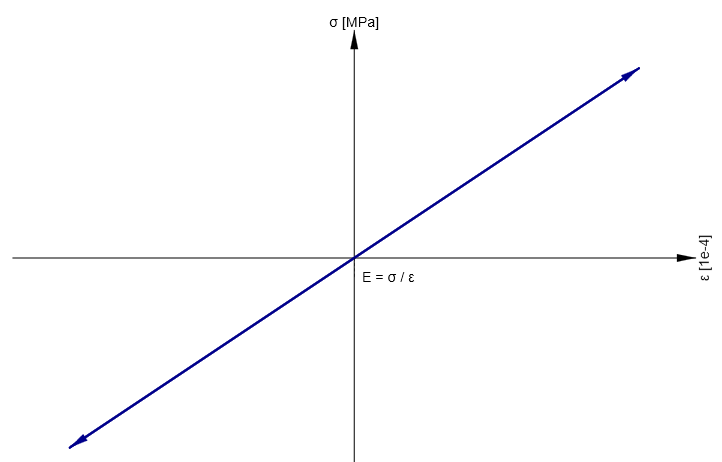
\[ \textsf{\textit{\footnotesize{Fig. 14\qquad The base plate material definition}}}\]
La platine de base peut être chargée par une charge ponctuelle (Fx, Fy, Fz, Mx, My, Mz) et un groupe de forces (Fx, Fy, Fz), principalement utilisé pour les modèles de chargement exportés depuis IDEA StatiCa Connection. Notez que les charges ponctuelles et les moments ponctuels chargent directement le nœud correspondant de la platine de base. Cela signifie qu'il n'y a pas de redistribution, uniquement par la rigidité de la platine de base.
Cette implémentation permet d'importer les effets de charge depuis IDEA StatiCa Connection, qui sont appliqués à la platine de base à l'emplacement des éléments finis de soudure individuels, avec la valeur et la direction déterminées à partir de la contrainte générale de cet élément fini de soudure. Des informations complémentaires sont disponibles dans le chapitre correspondant de ce document.
La deuxième option de chargement est le Tronçon — représentant une courte portion du poteau au-dessus de la platine de base. Le tronçon est modélisé comme une structure d'éléments de coque élastiques et se comporte comme une interface physiquement précise entre les efforts intérieurs et la platine. L'utilisateur sélectionne une section transversale pour le tronçon dans une base de données de sections standard. Le jeu de six composantes d'efforts intérieurs (forces et moments) est appliqué en un point unique sur la face inférieure du tronçon — c'est-à-dire la base du poteau. Des contraintes transfèrent les forces vers la face supérieure du tronçon, d'où elles sont naturellement redistribuées à travers le tronçon vers la platine de base, les ancrages et le béton.

\[ \textsf{\textit{\footnotesize{Fig. 15\qquad The load transfer through the stub}}}\]
Mécanisme de transfert du cisaillement (de la platine de base au bloc de béton)
Un contact par frottement en compression seule est défini entre la platine de base et le béton. Pour le transfert du cisaillement, l'utilisateur peut choisir parmi trois options :
- Par les ancrages
- Par frottement
- Par bêche
Le logiciel ne permet pas la combinaison de ces mécanismes de transfert du cisaillement.
Le coefficient de frottement doit être saisi comme une valeur de calcul (majorée). Si la résultante de l'effort tranchant Fxy dépasse l'effort de compression Fz multiplié par le coefficient de frottement μ, le calcul s'arrêtera et toutes les charges ne seront pas appliquées au modèle. La condition s'écrit comme suit :
\[\frac {F_{xy}}{ \mu \cdot F_{z}}\le 1\]
Cela peut être observé dans l'exemple suivant, où deux cas de charge sont considérés.
- LC1 - Type permanent - Fz = 100 kN
- LC2 - Type variable - Fx = 100 kN
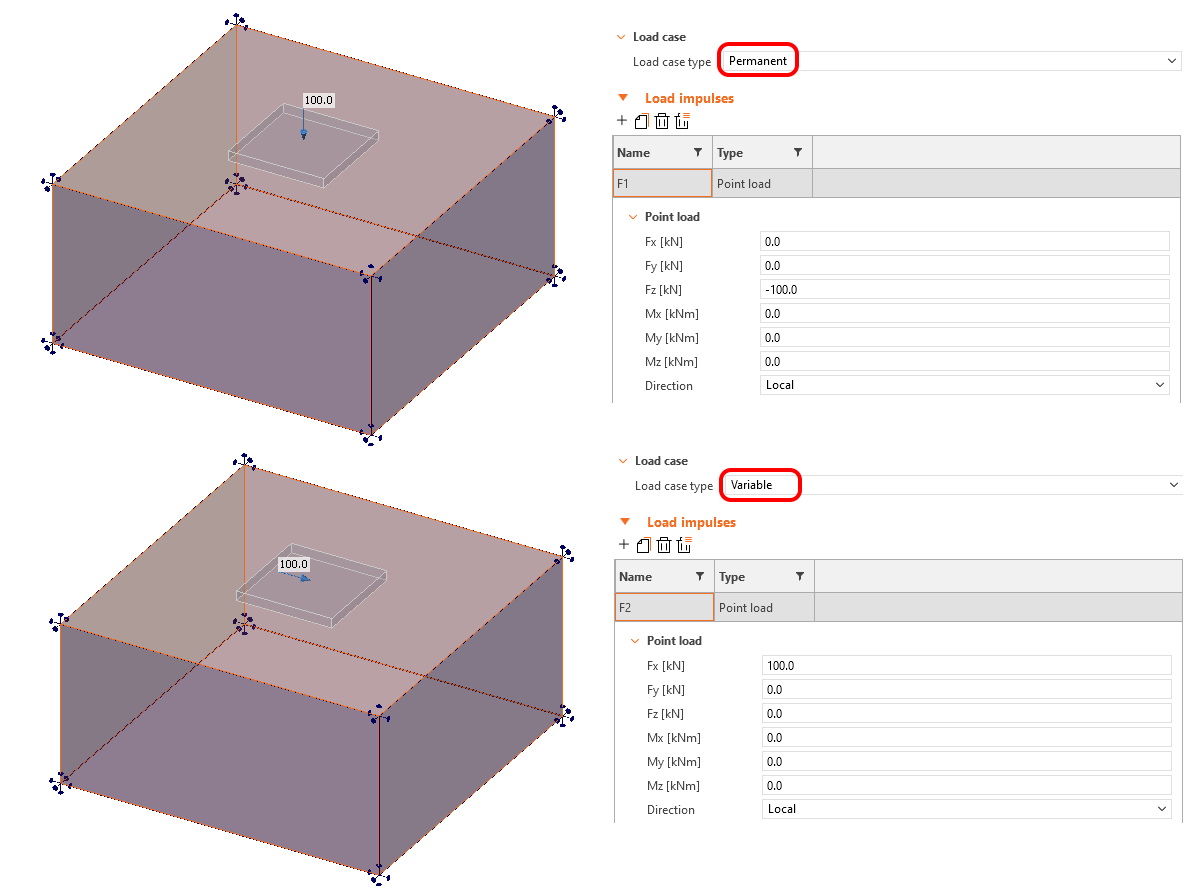
\[ \textsf{\textit{\footnotesize{Fig. 16\qquad Load input for example explaining shear transfer by friction}}}\]
Dans la première étape de calcul, toute la charge permanente est appliquée. Ensuite, la charge variable est progressivement appliquée jusqu'à ce qu'elle atteigne la valeur de la charge de compression multipliée par le coefficient de frottement.
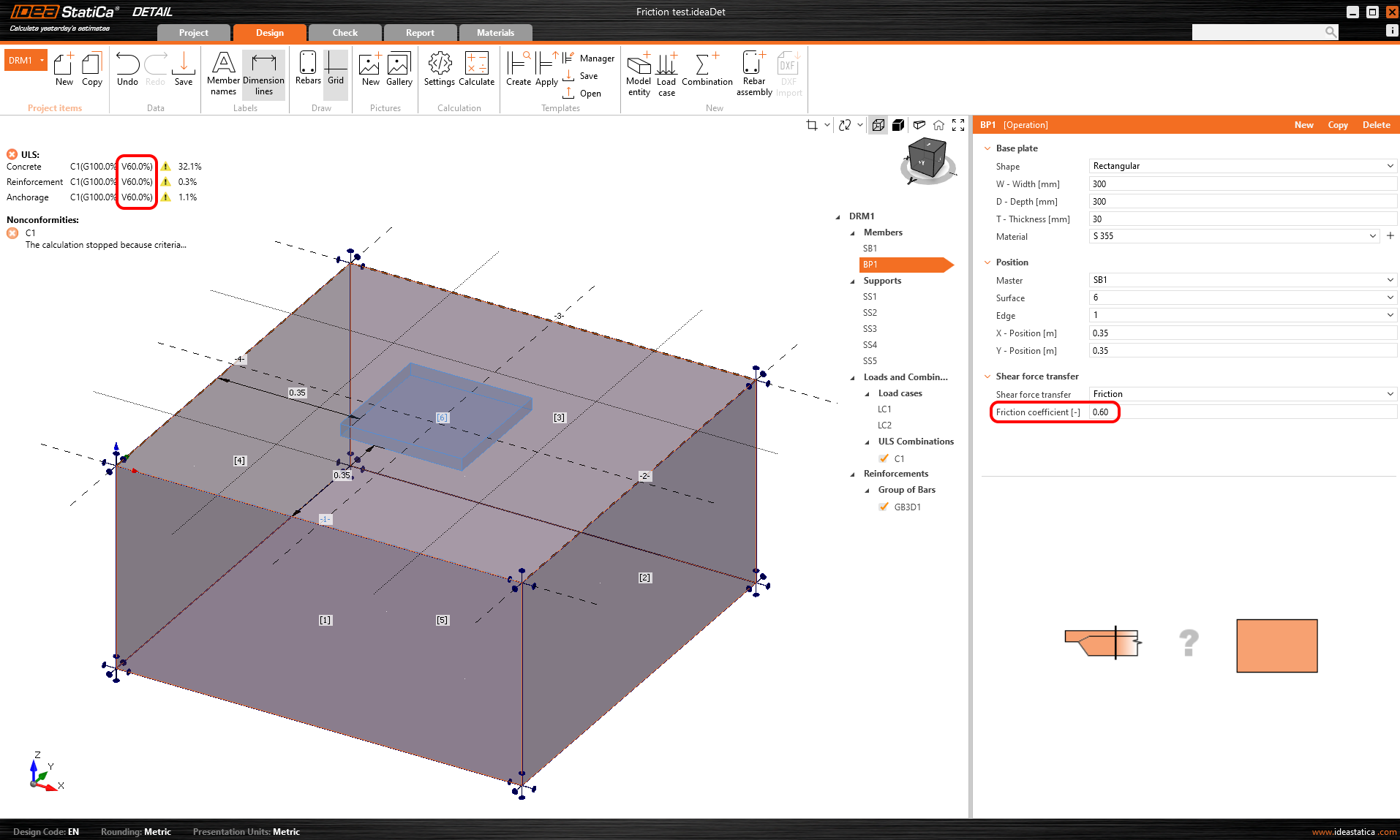
\[ \textsf{\textit{\footnotesize{Fig. 17\qquad Results from example explaining shear transfer by friction}}}\]
Le graphique de la Figure 18 définit le comportement du contact par frottement entre la platine de base et le béton.
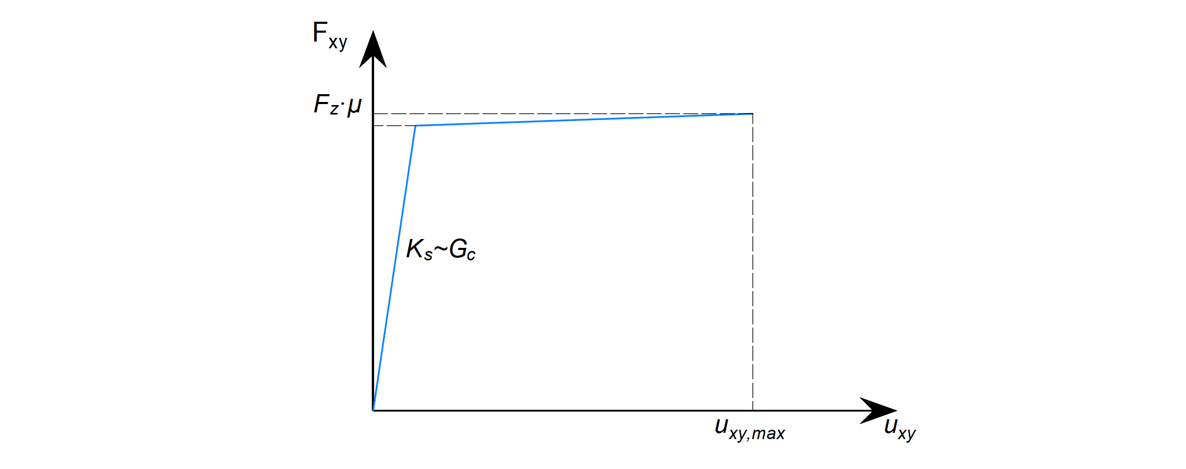
\[ \textsf{\textit{\footnotesize{Fig. 18\qquad Force-displacement graph describing the behavior of frictional contact}}}\]
La valeur de Fzμ diffère pour chaque incrément du calcul, tandis que la valeur de la déformation en cisaillement maximale uxy est constante.
Si l'effort normal de compression Fz et l'effort tranchant Fxy sont saisis dans un même type de cas de charge (par exemple, uniquement permanent), et que la condition Fxy / (Fzμ) ≤ 1 n'est pas satisfaite, aucune charge ne sera appliquée au modèle car la condition n'est satisfaite à aucun incrément du calcul.
La bêche est connectée au maillage de béton par des contraintes n'autorisant que le transfert de contrainte normale en compression seule.
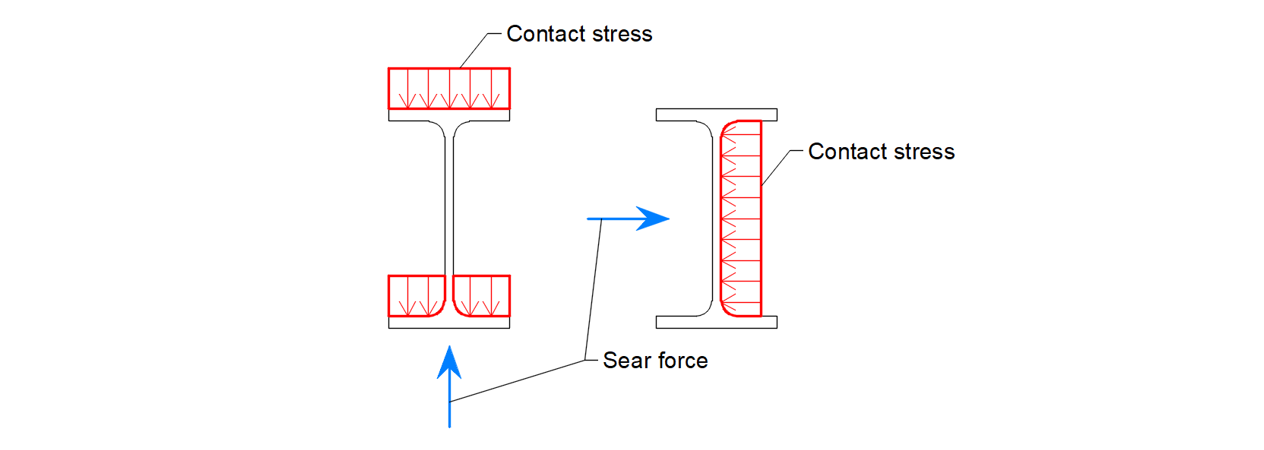
\[ \textsf{\textit{\footnotesize{Fig. 19\qquad Shear lug transfer of shear mechanism}}}\]
La bêche est modélisée à partir d'éléments de coque élastiques, où le module d'élasticité E définit le matériau.
Les résultats ne sont pas évalués ni affichés pour la platine de base ni pour la bêche.
Options de la platine de base (déport, coulis de scellement)
L'ensemble suivant d'options de déport, entièrement aligné avec l'application Connection, est disponible.
- Direct
- Joint de mortier – écrous par le dessus
- Joint de mortier – écrous par le dessus et par le dessous
- Jeu
La couche de mortier est modélisée comme un élément de coque, dont la rigidité est prise en compte. Notez que les éléments de coque sont incompressibles dans la direction de leur épaisseur. Cela contribue à redistribuer les forces locales vers le béton et est valable pour les épaisseurs de calage typiques utilisées en pratique — 25 à 50 mm.
La distinction entre les écrous uniquement par le dessus (liaison articulée entre l'ancrage et la platine de base) et par le dessus et le dessous (liaison encastrée entre l'ancrage et la platine de base) influence fortement la capacité au cisaillement du point de vue de l'appui sur le béton.
Ancrages
Les éléments finis représentant les ancrages sont modélisés de manière à pouvoir transférer des efforts normaux et des efforts tranchants vers le béton, en tenant également compte de la rigidité en flexion des ancrages. Pour modéliser le glissement entre l'ancrage et le béton environnant, les mêmes éléments d'adhérence et MPC que pour le ferraillage sont utilisés. À la différence que :
- Pour les ancrages post-installés (adhésifs), il est nécessaire de spécifier la résistance de calcul à l'adhérence.
- Pour les rondelles et les goujons à tête, l'adhérence est négligée le long du fût de l'ancrage. Toute la charge axiale est alors transférée au béton par la rondelle ou la tête de l'ancrage.
Les ancrages peuvent être interconnectés avec les platines de base. Pour cette interconnexion, une contrainte entièrement non linéaire est utilisée pour relier l'extrémité de l'ancrage à un nœud de la platine de base. Cette contrainte permet de contrôler tous les degrés de liberté afin de garantir, par exemple, que les ancrages ne transfèrent aucun effort de compression depuis la platine de base, ou qu'aucun cisaillement n'est transféré par l'ancrage lors de la modélisation d'une bêche, etc.
Les propriétés d'interconnexion avec la platine de base pour les ancrages permettent à l'utilisateur de contrôler si l'ancrage sera connecté à la platine de base par la contrainte mentionnée précédemment et de quelle manière.
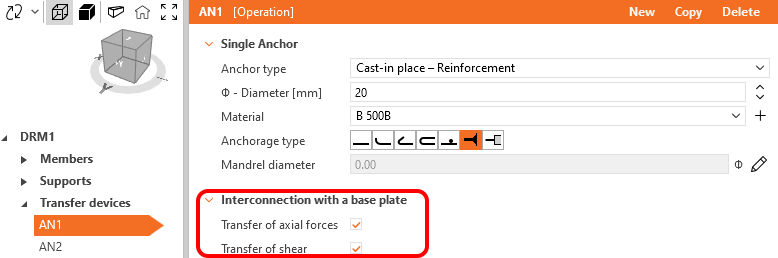
\[ \textsf{\textit{\footnotesize{Fig. 20\qquad Interconnection with base plate settings}}}\]
La case à cocher Transfert du cisaillement peut être utilisée pour contrôler si l'ancrage et la platine de base seront connectés ou non en termes de cisaillement. Notez qu'il n'est pas possible de combiner les mécanismes de transfert du cisaillement ; ainsi, pour le transfert par frottement et par bêche, cette case à cocher n'est pas pertinente. En revanche, pour le transfert du cisaillement par les ancrages, ce champ offre la possibilité d'exclure certains ancrages du transfert du cisaillement.
La case à cocher Transfert des efforts axiaux peut être utilisée pour contrôler si l'ancrage et la platine de base seront connectés ou non dans la direction axiale. Cela est principalement utilisé pour l'export depuis la fonctionnalité Connection (voir le chapitre correspondant). Pour la modélisation manuelle, il est logique d'avoir cette case à cocher toujours cochée.
Lorsque la case à cocher est décochée, l'ancrage est déconnecté à la fois en traction et en compression (dans le cas d'un modèle exporté depuis l'application Connection, la connexion est remplacée par une paire de forces). Si la case à cocher est cochée, l'ancrage est toujours connecté à la platine en traction, mais la connexion en compression est contrôlée par le type d'ancrage et le type de déport. Pour plus d'informations, voir la Figure 23.
Filets taillés
Contrôlé par une case à cocher dans les propriétés de l'ancrage et a 2 objectifs :
1. Définit comment l'ancrage se connecte à la platine de base :
- Pour les goujons à tête et le ferraillage coulé en place connecté à la platine de base (pas pour les platines coulées en place), cela distingue une connexion par boulon (articulée) d'une connexion soudée (encastrée) — visible dans la scène 3D.
- Notez que le mode de connexion ancrage-platine a une influence significative sur la résistance au cisaillement du point de vue de l'appui sur le béton.

\[ \textsf{\textit{\footnotesize{Fig. 21\qquad Cut threads options}}}\]
2. Pour l'Eurocode, la résistance de l'ancrage avec filets taillés est réduite conformément à EN 1993-1-8 3.6.1 (3). Cela peut être défini dans les paramètres du projet. Pour les tiges filetées et les rondelles, il est recommandé de conserver ce paramètre activé en permanence.
Interconnexion axiale et rotationnelle entre l'ancrage et la platine de base
Comme déjà mentionné dans ce chapitre, selon le type d'ancrage, le paramètre de déport et la prise en compte ou non des filets taillés, les ancrages sont connectés à la platine de base de différentes manières. En termes de connexion rotationnelle, cela peut être Articulé / Encastré. En termes de connexion axiale, cela peut être Traction / Traction + Compression. Les types de connexion rotationnelle influencent fortement la capacité au cisaillement du point de vue de l'appui sur le béton. Dans une scène 3D, il est facile de déterminer si un ancrage est connecté en mode encastré ou articulé en fonction de la présence d'écrous, voir Figure 22.

\[ \textsf{\textit{\footnotesize{Fig. 22\qquad Rotational constraints}}}\]
Le tableau suivant présente toutes les combinaisons possibles de connexions de platines de base avec des ancrages et les connexions rotationnelles et axiales correspondantes.

\[ \textsf{\textit{\footnotesize{Fig. 23\qquad Axial and rotational constraints between an anchor and a base plate}}}\]
Platines coulées en place
La platine coulée en place est un cas particulier de platine de base. Elle est modélisée de manière analogue avec les différences suivantes :
Étant donné que la platine est encastrée dans un bloc de béton, aucun type de déport ne peut être spécifié. La profondeur d'encastrement de la dalle est négligée. La platine, modélisée par des éléments de coque, est placée directement sur la surface du béton. Par conséquent, les surfaces latérales de la dalle ne sont pas considérées comme étant supportées par le béton.
Il est uniquement possible d'utiliser du ferraillage et des goujons à tête, qui, comme les ancrages classiques, peuvent être configurés pour être connectés à la dalle dans les directions axiale et de cisaillement. L'expérience pratique et certains documents nationaux indiquent la nécessité de dimensionner les goujons à tête uniquement pour le cisaillement et le ferraillage pour la charge axiale. Du point de vue des contraintes axiales et rotationnelles, les ancrages sont toujours connectés en mode Encastré et Traction + Compression.

\[ \textsf{\textit{\footnotesize{Fig. 24\qquad Axial and rotational constraints between an anchor and a base plate}}}\]
2.4 Maillage du béton en CSFM 3D
Les éléments finis sont implémentés en interne, et le modèle d'analyse est généré automatiquement sans nécessiter d'interaction experte de la part de l'utilisateur. Le maillage constitue une étape importante de ce processus.
Béton
Tous les éléments en béton sont maillés ensemble. Une taille d'élément recommandée est automatiquement calculée par l'application en fonction de la taille et de la forme de la structure, en tenant compte du diamètre de la plus grande barre de ferraillage. De plus, la taille d'élément recommandée garantit qu'un minimum de quatre éléments est généré dans les parties minces de la structure, telles que les poteaux élancés ou les voiles minces, afin d'assurer des résultats fiables dans ces zones. Les concepteurs peuvent toujours sélectionner une taille d'élément béton définie par l'utilisateur en modifiant le multiplicateur de la taille de maillage par défaut.
Ferraillage
Le ferraillage est divisé en éléments d'une longueur approximativement égale à la taille des éléments béton. Une fois les maillages du ferraillage et du béton générés, ils sont interconnectés par des éléments d'adhérence, comme illustré à la Fig. 9.
Raffinement
Le maillage béton est automatiquement raffiné autour des ancrages, autour des bêches, et sous le tronçon de chargement. La taille du maillage raffiné est environ deux fois plus petite que le maillage béton de base. Le rayon de la zone raffinée est défini approximativement comme la taille de l'élément multipliée par deux.
2.5 La méthode de résolution et l'algorithme de contrôle de charge pour le CSFM 3D
Un algorithme standard de Newton-Raphson (NR) complet est utilisé pour trouver la solution à un problème de Méthode des Éléments Finis non linéaire.
En général, l'algorithme NR ne converge pas souvent lorsque la charge totale est appliquée en une seule étape. Une approche habituelle, également utilisée ici, consiste à appliquer la charge de manière séquentielle en plusieurs incréments et à utiliser le résultat de l'incrément de charge précédent pour démarrer la résolution de Newton de l'incrément suivant. À cette fin, un algorithme de contrôle de charge a été implémenté en complément du Newton-Raphson. Dans le cas où les itérations NR ne convergent pas, l'incrément de charge actuel est réduit à la moitié de sa valeur, et les itérations NR sont relancées.
Un second objectif de l'algorithme de contrôle de charge est de trouver la charge critique, qui correspond à certains « critères d'arrêt » – plus précisément la déformation maximale dans le béton, le glissement maximal dans les éléments d'adhérence, le déplacement maximal dans les éléments d'ancrage, et la déformation maximale dans les barres de ferraillage. La charge critique est trouvée par la méthode de bissection. Dans le cas où le critère d'arrêt est dépassé en un point quelconque du modèle, les résultats du dernier incrément de charge sont rejetés et un nouvel incrément de la moitié de la taille du précédent est calculé. Ce processus est répété jusqu'à ce que la charge critique soit trouvée avec une certaine tolérance d'erreur.
Pour le béton, le critère d'arrêt a été fixé à une déformation de 5 % en compression (c'est-à-dire environ un ordre de grandeur supérieur à la déformation de rupture réelle du béton) et de 7 % en traction aux points d'intégration des éléments de coque. En traction, la valeur a été fixée pour permettre d'atteindre en premier la déformation limite dans le ferraillage, qui est généralement d'environ 5 % sans tenir compte du raidissement en traction. En compression, la valeur a été choisie parmi plusieurs alternatives comme étant suffisamment grande pour que les effets de l'écrasement soient visibles dans les résultats, mais suffisamment petite pour ne pas causer trop de problèmes de stabilité numérique.
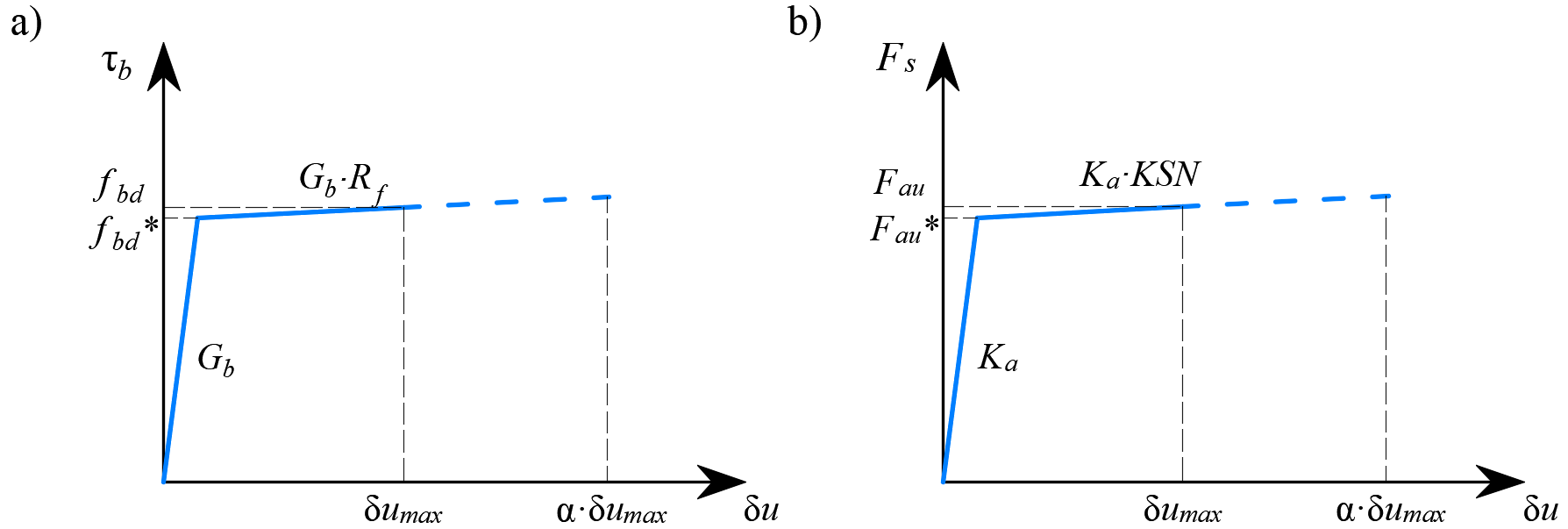
\[ \textsf{\textit{\footnotesize{Fig 25\qquad Constitutive law of bond and anchorage elements used for anchorage length verification: a) Bond shear stress}}}\] \[ \textsf{\textit{\footnotesize{slip response of bond element, b) force-displacement response of an anchorage element}}}\]
Pour le ferraillage, le critère d'arrêt est défini en termes de contraintes. Étant donné que les contraintes à la fissure sont modélisées, le critère en traction correspond à la résistance à la traction du ferraillage tenant compte du coefficient de sécurité. La même valeur est utilisée pour le critère en compression.
Le critère d'arrêt dans les éléments d'adhérence et les ressorts d'ancrage est α·δumax, où δumax est le glissement maximal utilisé dans les vérifications normatives et α = 10.
Autres critères d'arrêt pour l'ancrage :
- Arrachement des ancrages à tête (contrainte de compression de contact maximale sur la face supérieure de la tête de l'ancrage).
- Effort tranchant maximal pouvant être transféré par l'ancrage du point de vue de l'appui sur le béton.
Ces deux critères dépendent de la norme sélectionnée. Vous pouvez trouver plus d'informations à leur sujet dans les sections expliquant les parties dépendantes de la norme de l'analyse structurelle dans l'application.
2.6 Présentation des résultats 3D
Les résultats sont présentés indépendamment pour le béton et pour les éléments de ferraillage. Les valeurs de contrainte et de déformation dans le béton sont calculées aux points d'intégration des éléments volumiques. Cependant, comme il n'est pas pratique de présenter les données de cette manière, les résultats sont présentés par défaut aux nœuds, comme la valeur maximale de la contrainte de compression issue des points d'intégration de Gauss adjacents dans les éléments connectés. Il convient de noter que cette représentation peut localement sous-estimer les résultats aux bords comprimés des éléments dans le cas où la taille des éléments finis est similaire à la profondeur de la zone de compression.
Les résultats pour les éléments finis de ferraillage sont soit constants pour chaque élément (une valeur – par exemple, pour les contraintes dans l'acier), soit linéaires (deux valeurs – pour les résultats d'adhérence). Pour les éléments auxiliaires, tels que les éléments de plaques d'appui, seules les déformations sont présentées.
2.7 Modèle importé depuis IDEA StatiCa Connection
Le modèle IDEA StatiCa Detail ne doit pas toujours être modélisé de zéro ou à partir d'un modèle. Il existe également une option pour importer le modèle, y compris les effets de charge, depuis IDEA StatiCa Connection. Dans Connection, la superstructure acier au-dessus du bloc en béton est analysée à l'aide d'un modèle 3D non linéaire, tandis que le bloc en béton lui-même est représenté de manière simplifiée par une fondation de Winkler. Dans Detail, en revanche, le bloc en béton armé est modélisé explicitement et vérifié en détail.
Lors du transfert du modèle, seuls la platine de base, les ancrages et le bloc en béton sont importés dans Detail – l'élément acier lui-même (et sa rigidité globale) ne l'est pas. Dans le modèle Connection, cet élément acier est relié à la platine de base par une soudure. Les contraintes dans les éléments finis de soudure sont intégrées et converties en un ensemble de forces équivalentes qui chargent la platine de base dans Detail. De cette façon, l'effet de l'élément acier manquant est représenté par les forces de soudure appliquées directement à la platine de base.
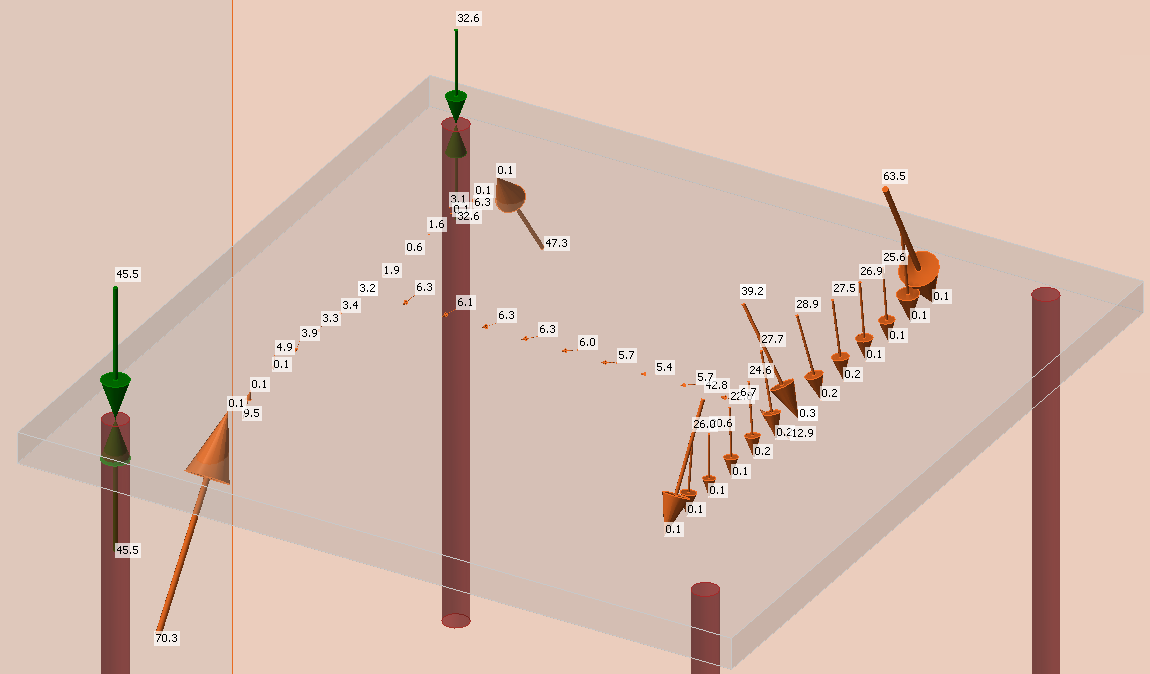
\[ \textsf{\textit{\footnotesize{Fig. 26\qquad Loads imported from IDEA StatiCa Connection}}}\]
En raison de la définition différente de la rigidité entre Connection et Detail (élément acier manquant, modèles de matériaux différents et représentation du béton), une connexion directe entre la platine de base et les ancrages dans Detail conduirait généralement à une redistribution différente des charges et, par conséquent, à des efforts de traction différents dans les ancrages. Pour éviter cela, les ancrages sont importés déconnectés axialement de la platine de base. Au lieu de transférer les efforts axiaux par contact physique, les efforts de traction des ancrages obtenus depuis Connection sont appliqués directement aux ancrages dans Detail. En même temps, une force égale et opposée est appliquée à la platine de base à chaque emplacement d'ancrage, de sorte que l'équilibre global du modèle est préservé. Cette paire de forces (l'une agissant sur l'ancrage, l'autre sur la platine de base) représente l'interaction entre la platine de base et l'ancrage sans permettre de redistribution supplémentaire des efforts axiaux dans Detail. Ces deux forces opposées sont illustrées à la Figure 26.
Cependant, les efforts tranchants sont toujours transférés par la connexion entre la platine de base et les ancrages (ou la bêche, ou le frottement). Cela est possible car une contrainte est utilisée pour relier la platine de base et les ancrages en cisaillement, nous permettant de contrôler les degrés de liberté pertinents de cette interconnexion. Dans Detail, l'utilisateur peut donc modifier le chemin de transfert des efforts tranchants – par exemple, en libérant le cisaillement dans deux des quatre ancrages et en ne maintenant que les ancrages de bord actifs en cisaillement – tandis que les efforts axiaux restent tels qu'importés depuis Connection.
Pour les platines coulées en place, nous avons adopté une approche différente. Plusieurs recommandations de conception européennes exigent que seules les barres de ferraillage soient considérées pour résister aux efforts axiaux, tandis que les goujons à tête sont supposés ne transférer que le cisaillement. Étant donné qu'IDEA StatiCa Connection ne peut pas séparer en interne les efforts axiaux dans les ancrages de ferraillage de ceux dans les goujons à tête lors de l'export, les ancrages des platines coulées en place sont importés dans Detail entièrement connectés, également dans la direction axiale. Cela permet à l'utilisateur d'activer une option de calcul dans Detail où les ancrages de ferraillage reprennent uniquement la traction axiale et les goujons à tête reprennent uniquement le cisaillement. Dans ce processus, l'effort axial qui était initialement assigné aux goujons à tête doit être redistribué sur les ancrages de ferraillage dans le modèle Detail. Une telle redistribution ne serait pas possible si nous utilisions l'approche par paire de forces opposées décrite ci-dessus, c'est pourquoi les platines coulées en place sont traitées différemment.
3 Vérification du modèle
3.1 États limites
État limite ultime
Les différentes vérifications requises par les codes de calcul spécifiques sont évaluées sur la base des résultats directs fournis par le modèle. Les vérifications à l'ELU sont effectuées pour la résistance du béton, la résistance du ferraillage et l'ancrage (contraintes de cisaillement d'adhérence).
Pour s'assurer qu'un élément structurel présente un dimensionnement efficace, il est fortement recommandé d'effectuer une analyse préliminaire en tenant compte des étapes suivantes :
- Choisir une sélection des combinaisons de charges les plus critiques.
- Calculer uniquement les combinaisons de charges à l'État Limite Ultime (ELU).
- Pour accélérer le temps de calcul et résoudre les éventuels problèmes, envisager d'utiliser un maillage grossier en augmentant le multiplicateur de la taille de maillage par défaut dans les Paramètres (Fig. 27). Si le modèle fonctionne correctement, remettre le multiplicateur à une valeur de 1.

\[ \textsf{\textit{\footnotesize{Fig 27\qquad Mesh multiplier}}}\]
Un tel modèle se calculera très rapidement, permettant aux concepteurs de vérifier le ferraillage de l'élément structurel de manière efficace et de relancer l'analyse jusqu'à ce que toutes les exigences de vérification soient satisfaites pour les combinaisons de charges les plus critiques. Une fois toutes les exigences de vérification de cette analyse préliminaire satisfaites, il est suggéré d'inclure l'ensemble des combinaisons de charges ultimes et d'utiliser une taille de maillage fine (la taille de maillage recommandée par le programme). Les utilisateurs peuvent modifier la taille du maillage par le multiplicateur, qui peut prendre des valeurs de 0,5 à 5 (Fig. 27).
Les résultats et vérifications de base (contrainte, déformation et taux de travail (c'est-à-dire la valeur calculée/valeur limite issue du code)), ainsi que la direction des contraintes principales dans le cas des éléments en béton) sont affichés au moyen de différents tracés où la compression est généralement représentée en rouge et la traction en bleu. Les valeurs minimales et maximales globales pour l'ensemble de la structure peuvent être mises en évidence, ainsi que les valeurs minimales et maximales pour chaque partie définie par l'utilisateur. Dans un onglet séparé du programme, des résultats avancés tels que les valeurs tensorielles, les déformations de la structure et les taux de ferraillage (effectifs et géométriques) utilisés pour le calcul du raidissement en traction des barres de ferraillage peuvent être affichés. De plus, les charges et réactions pour les combinaisons ou cas de charge sélectionnés peuvent être présentés.
4 Vérifications structurelles selon l'EUROCODE
4.1 Modèles de matériaux dans le CSFM 3D (EN)
Béton - ELU
Le modèle de béton implémenté dans le CSFM 3D est basé sur les lois de comportement uniaxiales en compression prescrites par EN 1992-1-1 pour le calcul des sections transversales, qui ne dépendent que de la résistance en compression. Le diagramme parabole-rectangle spécifié dans EN 1992-1-1 Art. 3.1.7 (1) (Fig. 28a) est utilisé par défaut dans le CSFM 3D, mais les concepteurs peuvent également choisir une relation élastique-plastique parfaite simplifiée conformément à EN 1992-1-1 Art. 3.1.7 (2) (Fig. 28b). La résistance en traction est négligée, comme c'est le cas dans le calcul classique du béton armé.

\[ \textsf{\textit{\footnotesize{Fig 28\qquad The stress-strain diagrams of concrete for ULS: a) parabola-rectangle diagram; b) bilinear diagram}}}\]
L'implémentation du CSFM 3D dans IDEA StatiCa Detail ne considère pas de critère de rupture explicite en termes de déformations pour le béton en compression (c'est-à-dire qu'après l'atteinte de la contrainte maximale, elle considère une branche plastique avec εcu2 (εcu3) à une valeur de 5% alors que EN 1992-1-1 suppose une déformation ultime inférieure à 0,35%). Cette simplification ne permet pas de vérifier la capacité de déformation des structures dont la rupture se produit en compression. Cependant, leur capacité ultime fcd selon EN 1992-1-1 3.1.3 est correctement prédite lorsque l'augmentation de la fragilité du béton avec sa résistance est prise en compte au moyen du facteur de réduction \(\eta_{fc}\) défini dans le fib Model Code 2010 comme suit :
\[f_{cd}={\alpha_{cc}} \cdot \frac{f_{ck,red}}{γ_c} = {\alpha_{cc}} \cdot \frac{\eta _{fc} \cdot f_{ck}}{γ_c}\]
\[{\eta _{fc}} = {\left( {\frac{{30}}{{{f_{ck}}}}} \right)^{\frac{1}{3}}} \le 1\]
où :
αcc est le coefficient tenant compte des effets à long terme sur la résistance en compression et des effets défavorables résultant du mode d'application de la charge. Il est conforme à EN 1992-1-1 Art. 3.1.6 (1). La valeur par défaut est 1,0.
fck est la résistance caractéristique sur cylindre du béton (en MPa pour la définition de \( \eta_{fc} \)).
Ferraillage
Par défaut, le diagramme contrainte-déformation bilinéaire idéalisé pour les barres de ferraillage nues défini dans EN 1992-1-1, section 3.2.7 (Fig. 29) est pris en compte. La définition de ce diagramme ne nécessite que la connaissance des propriétés de base du ferraillage lors de la phase de calcul (résistance et classe de ductilité). Lorsqu'elles sont connues, la relation contrainte-déformation réelle du ferraillage (laminé à chaud, écrouissage à froid, trempé et auto-revenu, …) peut être prise en compte. Le diagramme contrainte-déformation du ferraillage peut être défini par l'utilisateur, mais dans ce cas, il est impossible de supposer l'effet de raidissement en traction (il est impossible de calculer la largeur des fissures). L'utilisation du diagramme contrainte-déformation avec une branche supérieure horizontale ne permet pas la vérification de la durabilité structurelle. Par conséquent, une vérification manuelle des exigences de ductilité normatives est nécessaire.

\[ \textsf{\textit{\footnotesize{Fig. 29 \qquad Stress-strain diagram of reinforcement: a) bilinear diagram with an inclined top branch; b) bilinear diagram}}}\] \[ \textsf{\textit{\footnotesize{with a horizontal top branch.}}}\]
Le raidissement en traction (Fig. 30) est pris en compte automatiquement en modifiant la relation contrainte-déformation d'entrée de la barre de ferraillage nue afin de capturer la rigidité moyenne des barres noyées dans le béton (εm).

\[ \textsf{\textit{\footnotesize{Fig. 30\qquad Scheme of tension stiffening.}}}\]
4.2 Facteurs partiels de sécurité
La Méthode du Champ de Contraintes Compatible est conforme aux codes de calcul modernes. Étant donné que les modèles de calcul n'utilisent que des propriétés matérielles standard, le format des facteurs partiels de sécurité prescrit dans les codes de calcul peut être appliqué sans aucune adaptation. Ainsi, les charges appliquées sont pondérées et les propriétés caractéristiques des matériaux sont réduites à l'aide des coefficients de sécurité respectifs prescrits dans les codes de calcul, exactement comme dans l'analyse conventionnelle du béton. Les valeurs des facteurs partiels de sécurité des matériaux prescrits dans EN 1992-1-1 chap. 2.4.2.4 et les facteurs pour les ancrages prescrits dans EN 1992-4, EN 1993-1-8 et EN 1994-1-1 sont définis par défaut, mais l'utilisateur peut modifier les facteurs de sécurité dans les paramètres de code et de calcul (Fig. 31).

\[ \textsf{\textit{\footnotesize{Fig. 31\qquad The setting of material safety factors in Idea StatiCa Detail.}}}\]
Les facteurs partiels de charge doivent être définis par l'utilisateur dans les règles de combinaison pour chaque combinaison non linéaire de cas de charge (Fig. 32). Pour tous les modèles implémentés dans Idea StatiCa Detail, les facteurs partiels de sécurité sont déjà prédéfinis.
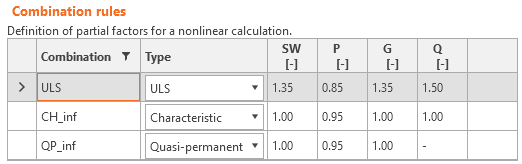
\[ \textsf{\textit{\footnotesize{Fig. 32\qquad The setting of load partial factors in Idea StatiCa Detail.}}}\]
En utilisant des combinaisons appropriées de facteurs partiels de sécurité définis par l'utilisateur, celui-ci peut également effectuer des calculs avec le CSFM 3D en utilisant la méthode du facteur de résistance global (Navrátil, et al. 2017), mais cette approche est rarement utilisée dans la pratique de conception. Certaines directives recommandent d'utiliser la méthode du facteur de résistance global pour l'analyse non linéaire. Cependant, dans les analyses non linéaires simplifiées (telles que le CSFM 3D), qui ne nécessitent que les propriétés matérielles utilisées dans les calculs manuels conventionnels, il est encore plus souhaitable d'utiliser le format des facteurs partiels de sécurité.
4.3 Vérifications à l'état limite ultime
5 Vérifications structurelles selon ACI 318-19
Le CSFM 3D est conforme à ACI 318-19, chapitre 6.8.1.1. Afin que le CSFM 3D satisfasse aux exigences de la section 6.8.1.2 de l'ACI 318-19, de nombreux essais de vérification ont été réalisés dans diverses universités. Des articles individuels résumant les résultats de vérification et de validation sont disponibles au lien suivant.
5.1 Modèles de matériaux dans le CSFM 3D (ACI)
Béton - Résistance
Le modèle de béton mis en œuvre pour les calculs de résistance dans le CSFM est basé sur la courbe contrainte-déformation parabolique-plastique du béton, fondée sur la courbe parabolique contrainte-déformation de la Portland Cement Association décrite dans les Notes de la PCA sur les exigences du Code de construction ACI 318-99 pour le béton structurel, Figure 6-8. La résistance à la traction est négligée, comme c'est le cas dans le calcul classique du béton armé.

\[ \textsf{\textit{\footnotesize{Fig. 40\qquad The stress-strain diagram of concrete for Strength analysis}}}\]
La mise en œuvre du CSFM dans IDEA StatiCa Detail ne prend pas en compte de critère de rupture explicite en termes de déformations pour le béton en compression (c'est-à-dire qu'après l'atteinte de la contrainte maximale, elle considère une branche plastique avec εc0 à une valeur maximale de 5 %, tandis que l'ACI 318-19 Cl. 22.2.2.1 suppose une déformation ultime inférieure à 0,3 %). Cette simplification ne permet pas de vérifier la capacité de déformation des structures dont la rupture se produit en compression. Cependant, la résistance est correctement prédite lorsque l'augmentation de la fragilité du béton avec sa résistance est prise en compte au moyen du facteur de réduction \(\eta_{fc}\) défini dans le fib Model Code 2010 comme suit :
\[f'_{c,lim}=\alpha_{1}\cdot\phi_{c}\cdot \eta _{fc}\cdot f'_{c}\]
\[{\eta _{fc}} = {\left( {\frac{{30}}{{{f'_{c}}}}} \right)^{\frac{1}{3}}} \le 1\]
où :
α1 est le facteur de réduction de la résistance à la compression du béton défini dans l'ACI 318-19 Cl. 22.2.2.4.1. Lors de l'utilisation d'un diagramme contrainte-déformation parabolique-rectangulaire, il est nécessaire de réduire la contrainte de compression maximale par ce facteur. Cela permet de moyenner la distribution des contraintes dans la zone comprimée de telle sorte que la résistance à la compression résultante soit inférieure ou égale à la résistance à la compression calculée à l'aide d'un diagramme contrainte-déformation avec une branche plastique décroissante.
Φc est le facteur de réduction de résistance pour le béton. La valeur par défaut est fixée conformément à l'ACI 318-19 Tableau 24.2.1 (b)(f).
f'c est la résistance sur cylindre du béton (en MPa pour la définition de \( \eta_{fc} \)).
Ferraillage
Un diagramme contrainte-déformation élasto-plastique parfait avec un point de limite d'élasticité défini est considéré pour le ferraillage non précontraint. Voir ACI 319-19 Cl. 20.2.1. La définition de ce diagramme ne nécessite que la connaissance des propriétés de base du ferraillage — résistance et module d'élasticité.
Le diagramme contrainte-déformation du ferraillage peut également être défini par l'utilisateur, mais dans ce cas, il est impossible de prendre en compte l'effet de raidissement en traction.

\[ \textsf{\textit{\footnotesize{Fig. 41 \qquad Stress-strain diagram of reinforcement}}}\]
où :
Φs est le facteur de réduction de résistance pour le ferraillage. La valeur par défaut est fixée conformément à l'ACI 318-19 Tableau 24.2.1.
fy est la limite d'élasticité du ferraillage
Es est le module d'élasticité du ferraillage
10 % est sélectionné comme déformation limite à laquelle le calcul est arrêté. Cela est considéré comme sûr sur la base de l'ASTM A955/A955M-20c Article 7.
Le raidissement en traction (Fig. 42) est pris en compte automatiquement en modifiant la relation contrainte-déformation d'entrée de la barre d'armature nue afin de capturer la rigidité moyenne des barres noyées dans le béton (εm).

\[ \textsf{\textit{\footnotesize{Fig. 42\qquad Scheme of tension stiffening.}}}\]
5.2 Facteurs de réduction de résistance et facteurs de charge
La Méthode du Champ de Contraintes Compatible est conforme aux codes de conception modernes. Comme les modèles de calcul n'utilisent que des propriétés matérielles standard, le format des coefficients partiels de sécurité prescrit dans les codes de conception peut être appliqué sans aucune adaptation. Ainsi, les charges d'entrée sont pondérées et les propriétés matérielles caractéristiques sont réduites à l'aide des facteurs de réduction de résistance respectifs, exactement comme dans l'analyse conventionnelle du béton.
Les valeurs des facteurs de réduction de résistance sont prescrites dans le chapitre 21 de l'ACI 318-19 et pour les ancrages dans le chapitre 17 de l'ACI 318-19 et les chapitres D, E, F, G de l'AISC 360-16.

\[ \textsf{\textit{\footnotesize{Fig. 43\qquad The setting of strength reduction factors in IDEA StatiCa Detail.}}}\]
Les facteurs de charge pour les combinaisons de résistance doivent être définis conformément au Tableau 5.3.1 de l'ACI 318-19.
Sauf disposition contraire au Chapitre 34, les combinaisons de charges au niveau de service ne sont pas définies dans l'ACI 318-19. Il est recommandé d'utiliser les règles de combinaison basées sur l'Annexe C de l'ASCE/SEI 7-16. Pour tous les modèles, les facteurs de charge sont déjà prédéfinis.

\[ \textsf{\textit{\footnotesize{Fig. 44\qquad The setting of load factors in IDEA StatiCa Detail.}}}\]
5.3 Vérifications de résistance dans Detail 3D
Les différentes vérifications requises par ACI 318-19 sont évaluées sur la base des résultats directs fournis par le modèle. Les vérifications sont effectuées pour la résistance du béton, la résistance du ferraillage et l'ancrage (contraintes de cisaillement d'adhérence).
Résistance - Béton
La résistance du béton en compression est évaluée comme le rapport entre la contrainte principale équivalente maximale fc,eq (également σc,eq dans le texte précédent) obtenue par l'analyse par éléments finis et la valeur limite f'c,lim.
La contrainte principale équivalente exprime la contrainte uni-axiale équivalente pour un état de contrainte tri-axial général.
\[f_{c,eq} = \sigma_{c3} - \sigma_{c1}\]
La valeur fc,eq peut donc être directement comparée aux limites de résistance uni-axiale. Cette expression est dérivée de l'implémentation de la théorie de plasticité de Mohr-Coulomb, en supposant de manière conservative un angle de frottement interne φ = 0°.
Résistance - Ferraillage
La résistance du ferraillage est évaluée en traction et en compression comme le rapport entre la contrainte dans le ferraillage aux fissures fs et la valeur limite spécifiée fy,lim.
\[f_{y,lim} = \phi_{s} \cdot f_{y}\]
Résistance - Ancrages
Les ancrages sont vérifiés pour les contraintes normales de manière similaire au ferraillage, où la valeur limite fy,lim est déterminée.
Pour faciliter la navigation dans le texte suivant, nous allons d'abord diviser l'ancrage en trois groupes en termes de vérification normative selon ACI ou AISC.
Groupe 1
- Types d'ancrage
- Platine coulée en place
- Platine de base - Stand-off = direct
- Platine de base - Stand-off = Joint de mortier - épaisseur du mortier inférieure à 0,5 fois le diamètre de l'ancrage
- Ancrage unique avec longueur projetée inférieure à 0,5 fois le diamètre de l'ancrage
- Vérifications normatives des ancrages (ACI / AISC)
- Traction/compression
- Tous les types d'ancrage en traction – ACI 318-19 chap. 17.6.1.2
- Tous les types d'ancrage en compression – AISC 360-16 chap. E
- Cisaillement sans bras de levier
- Matériau boulon – ACI 318-19 chap. 17.7.1.2 (b)
- Goujons à tête – ACI 318-19 chap. 17.7.1.2 (a)
- Ferraillage – ACI 318-19 chap. 17.7.1.2 (b)
- Interaction traction et cisaillement - ACI 318-19 chap. 17.8
- Traction/compression
Groupe 2
- Types d'ancrage
- Platine de base - Stand-off = Joint de mortier - épaisseur du mortier supérieure à 0,5 fois le diamètre de l'ancrage
- Vérifications normatives des ancrages (ACI / AISC)
- Traction/compression
- Tous les types d'ancrage en traction – ACI 318-19 chap. 17.6.1.2
- Tous les types d'ancrage en compression – AISC 360-16 chap. E
- Cisaillement avec bras de levier
- Matériau boulon – ACI 318-19 chap. 17.7.1.2 (b) + chap. 17.7.1.2.1.
- Goujons à tête – ACI 318-19 chap. 17.7.1.2 (a) + chap. 17.7.1.2.1.
- Ferraillage – ACI 318-19 chap. 17.7.1.2 (b) + chap. 17.7.1.2.1.
- Interaction traction et cisaillement - ACI 318-19 chap. 17.8
- Traction/compression
Groupe 3
- Types d'ancrage
- Platine de base - Stand-off = jeu
- Ancrage unique avec longueur projetée supérieure à 0,5 fois le diamètre de l'ancrage
- Vérifications normatives des ancrages (ACI / AISC)
- Traction/compression (avec flambement)
- Tous les types d'ancrage en traction – ACI 318-19 chap. 17.6.1.2
- Tous les types d'ancrage en compression – AISC 360-16 chap. E3
- Flexion
- Pour tous les types d'ancrage – AISC 360-16 chap. F11
- Cisaillement
- Pour tous les types d'ancrage – AISC 360-16 chap. G
- Interaction effort axial et flexion
- \(\dfrac{N}{P_n}+\dfrac{M}{M_n}\le 1\)
- Traction/compression (avec flambement)
Résistance en traction de l'ancrage selon ACI 318-19 chap. 17.6.1.2
\[\phi N_{sa}=\phi_{a,t}\,A_{se,N}\,f_{uta}\]
où :
- ϕa,t – facteur de réduction de résistance pour les ancrages en traction selon ACI 318-19 chap. 17.5.3 (a)
- Ase,N – aire de la section résistante en traction (réduite par le filetage)
- futa – résistance en traction spécifiée de l'acier d'ancrage, ne devant pas être supérieure à 1,9 fya et 860 MPa
Résistance au cisaillement de l'ancrage selon ACI 318-19 chap. 17.7.1.2 (a)
La résistance de l'acier au cisaillement pour les goujons à tête est déterminée comme suit :
\[\phi V_{sa}=\phi_{a,V}\,A_{se,V}\,f_{uta}\]
où :
ϕa,v – facteur de réduction de résistance pour les ancrages en traction selon ACI 318-19 chap. 17.5.3 (a)
Ase,V – aire de la section résistante en traction (réduite par le filetage)
futa – résistance en traction spécifiée de l'acier d'ancrage, ne devant pas être supérieure à 1,9 fya et 860 MPa
Résistance au cisaillement de l'ancrage selon ACI 318-19 chap. 17.7.1.2 (b)
La résistance de l'acier au cisaillement pour les ancrages en matériau boulon et ferraillage est déterminée comme suit :
\[\phi V_{sa}=\phi_{a,V}\,0.6\,A_{se,V}\,f_{uta}\]
où :
- ϕa,v – facteur de réduction de résistance pour les ancrages en traction selon ACI 318-19 chap. 17.5.3 (a)
- Ase,V – aire de la section résistante en traction (réduite par le filetage)
- futa – résistance en traction spécifiée de l'acier d'ancrage, ne devant pas être supérieure à 1,9 fya et 860 MPa
Résistance au cisaillement de l'ancrage connecté à une base avec mortier - ACI 318-19 chap. 17.7.1.2.1
Si des ancrages sont utilisés avec des joints de mortier rapportés (Groupe 2), la résistance de calcul calculée conformément au chap. 17.7.1.2 doit être multipliée par 0,80.
Interaction en traction et cisaillement selon ACI 318-19 chap. 17.8
Il est permis de négliger l'interaction entre traction et cisaillement si (a) ou (b) est satisfait.
(a) Nua/(ϕNn) ≤ 0,2
(b) Vua/(ϕVn) ≤ 0,2
Si Nua/(ϕNn) > 0,2 pour la résistance déterminante en traction et Vua/(ϕVn) > 0,2 pour la résistance déterminante au cisaillement, alors l'Éq. (17.8.3) doit être satisfaite.
\[\frac{N_{ua}}{\phi N_n}+\frac{V_{ua}}{\phi V_n}\le 1.2\]
Résistance en compression de l'ancrage selon AISC 360-16 chap. E3
\[P_n =\phi_{a,c}\, F_{cr}\, A_{g}\]
où :
- ϕa,t – facteur de réduction de résistance pour les ancrages en compression selon AISC 360-16 chap. E1
- (a) Lorsque : \(\dfrac{L_c}{r} \le 4.71\sqrt{\dfrac{E}{F_y}}\quad\) ou \(\dfrac{F_y}{F_e}\le 2.25\)
- \(F_{cr}=\left(0.658^{\,F_y/F_e}\right)F_y\)
- \(F_{cr}=\left(0.658^{\,F_y/F_e}\right)F_y\)
- (b) Lorsque : \(\dfrac{L_c}{r} > 4.71\sqrt{\dfrac{E}{F_y}}\quad\) ou \(\dfrac{F_y}{F_e}> 2.25\)
- \(F_{cr}=0.877F_e\)
- \(F_{cr}=0.877F_e\)
- Ag – aire brute de la section transversale de l'élément
- E – module d'élasticité de l'acier
- \(F_e=\dfrac{\pi^2 E}{\left(\dfrac{L_c}{r}\right)^2}\) - contrainte de flambement élastique
- Fy – limite d'élasticité minimale spécifiée du type d'acier utilisé
- \(r=\sqrt{\dfrac{I}{A_s}}\) – rayon de giration
- \(I=\dfrac{\pi d_s^4}{64}\) – moment d'inertie du boulon
Résistance en flexion de l'ancrage selon AISC 360-16 chap. F11
\[M_n=\phi_{a,b}\, Z\, F_y\, \le 1.6\,\phi_{a,b}\, S_x\, F_y\]
où :
- \(Z=\dfrac{d_s^{3}}{6}\) – module de plasticité de la section du boulon
- \(S_x=\dfrac{2I}{d_s}\) – module élastique de la section du boulon
Résistance au cisaillement de l'ancrage selon AISC 360-16 chap. G
\[V_n=\phi_{a,v}\,0.6\,A_v\,F_y\]
où :
- AV = 0.844As – l'aire de cisaillement
- As – l'aire du boulon réduite par le filetage
Écrasement du béton à l'interface ancrage–béton
La résistance au cisaillement de l'ancrage est également limitée du point de vue de l'écrasement du béton à l'interface ancrage–béton. Les valeurs limites et la méthode pour les déterminer sont décrites en détail dans l'article - Comportement au cisaillement des ancrages dans le béton armé. Une fois que la force de contact atteint cette limite, le critère d'arrêt est déclenché et l'analyse est interrompue avant que la résistance ne soit dépassée.
Vérification de l'arrachement pour les ancrages à tête (rondelles et goujons à tête)
Pour les ancrages à tête, un critère d'arrêt supplémentaire est mis en œuvre pour vérifier l'appui du béton (écrasement) au-dessus de la tête de l'ancrage - arrachement. Au cours de l'analyse, l'effort de compression transmis par le contact tête-béton est surveillé et comparé à la valeur limite donnée par ACI 318-19, Article 17.6.3.2.2a (rupture par arrachement des éléments de fixation à tête).
\[N_{pn} = \Phi \cdot \Psi_{c,p} \cdot 8 \cdot A_{brg} \cdot f'_c\]
où :
- \( \Phi\) est le facteur de réduction de résistance - Tableau 17.5.3(c)
- Abrg aire d'appui nette de la tête du goujon, du boulon d'ancrage ou de la barre déformée à tête (sans l'aire de la tige).
- f'c est la résistance en compression spécifiée du béton
- \(\Psi_{c,p}\) est le facteur de fissuration à l'arrachement selon 17.6.3.3, et est toujours pris égal à 1,0, c'est-à-dire la valeur pour le béton fissuré. Ceci est cohérent avec l'approche CSFM utilisée dans Detail, où la résistance en traction du béton est négligée et le béton est supposé fissuré en traction.
Une fois que la force de contact atteint cette limite normative, le critère d'arrêt est déclenché et l'analyse est interrompue avant que la résistance à l'arrachement ne soit dépassée.
Ancrage - Contrainte d'adhérence
La contrainte de cisaillement d'adhérence est évaluée indépendamment comme le rapport entre la contrainte d'adhérence τb calculée par l'analyse par éléments finis et la résistance d'adhérence fbu.
Bien que la résistance d'adhérence ne soit pas explicitement définie dans ACI 318-19, le calcul de la longueur de développement se trouve à la Section 25.4.2. Cependant, étant donné que la résistance d'adhérence est la donnée de base pour déterminer la longueur de développement, voir R25.4.1.1 et ACI Committee 408 1966, la résistance d'adhérence peut être calculée comme suit :
Supposons que si nous ancrons la barre de ferraillage dans un bloc de béton sur la longueur de développement ld ou plus, l'arrachement du ferraillage conduira à la rupture du ferraillage et non à l'arrachement du béton. Cela peut s'écrire avec la formule suivante.
\[\pi\cdot d_{b} \cdot l_{d} \cdot f_{bu}=f_{y}\cdot A_{s}\]
où :
db est le diamètre de la barre de ferraillage, ld est la longueur de développement, fbu est la résistance d'adhérence, fy est la limite d'élasticité du ferraillage, et As est l'aire de la barre de ferraillage.
À partir de ce qui précède, la formule de calcul de la résistance d'adhérence peut être facilement dérivée :
\[f_{bu}=\frac{f_{y}\cdot A_{s}}{\pi\cdot d_{b} \cdot l_{d} }\]
La longueur de développement ld est ensuite déterminée selon ACI 318-19 Tableau 25.4.2.3 comme suit :
\[l_{d}=\left( \frac{f_{y}\cdot\psi_{t}\cdot\psi_{e}\cdot\psi_{g}}{C\cdot\lambda\sqrt{f'_{c}}} \right)\cdot d_{b}\]
où :
C = 25 (2,1 pour le système métrique) pour les barres n° 6 et inférieures et les fils déformés, C = 20 (1,7 pour le système métrique) pour les barres n° 7 et supérieures, λ = 1,0 pour le béton de poids normal, ψt, ψe, ψg sont déterminés selon ACI 318-19 Tableau 25.4.2.3.
Seul le ferraillage non revêtu ou zingué (galvanisé) est pris en charge, donc ψe = 1,0. ψg est automatiquement déterminé à partir de la nuance du ferraillage, et ψt est automatiquement dérivé de la position du ferraillage dans le modèle et de la direction de bétonnage qui peut être définie dans l'application pour chaque élément de projet comme suit.
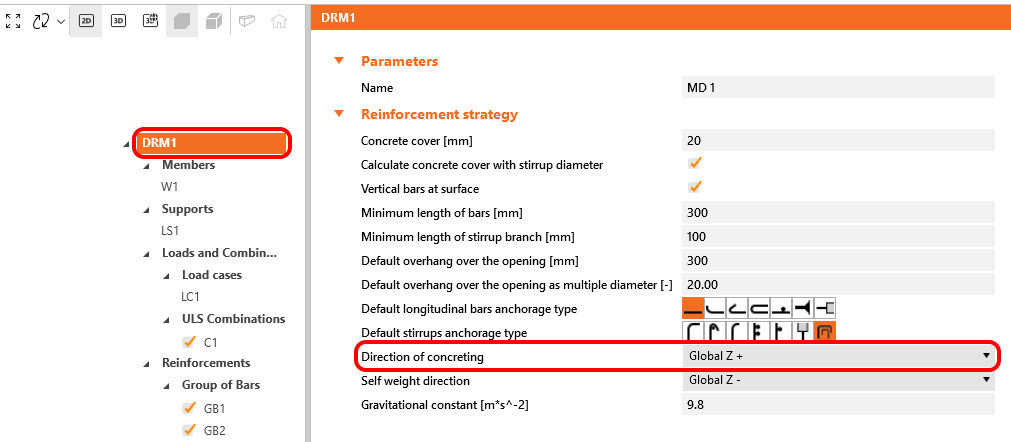
\[ \textsf{\textit{\footnotesize{Fig. 45\qquad Direction of concreting}}}\]
Ces vérifications sont effectuées par rapport aux valeurs limites appropriées pour les parties respectives de la structure (c'est-à-dire que malgré une nuance unique pour le béton et le ferraillage, les diagrammes contrainte-déformation finaux différeront dans chaque partie de la structure en raison des effets de raidissement en traction et d'adoucissement en compression).
Ancrage - Force totale
Force totale Ftot et force limite Flim
La force totale Ftot est un résultat de l'analyse par éléments finis et peut être définie de deux manières.
\[F_{tot}=A_{s} \cdot f_{s}\]
où As est l'aire de la barre de ferraillage et fs est la contrainte dans la barre.
Ou comme la somme de la force d'ancrage Fa et de la force d'adhérence Fbond.
\[F_{tot}=F_{a}+F_{bond}\]
où Fa est la force réelle dans le ressort d'ancrage et Fbond est la force d'adhérence qui peut être obtenue en intégrant la contrainte d'adhérence τb sur la longueur de la barre de ferraillage l.
\[F_{bond}=C_{s} \cdot \int_{0}^{l}\tau_{b}\left( x \right)dx\]
Cs est le périmètre de la barre de ferraillage.
La force limite Flim est la force maximale dans l'élément de la barre en tenant compte de la résistance de la barre et également des conditions d'ancrage (adhérence entre le béton et le ferraillage et crochets d'ancrage, boucles, etc.).
\[F_{lim}=min\left( F_{lim,bond}+F_{au},F_{u} \right)\]
\[F_{u}=f_{y,lim}\cdot A_{s}\]
\[F_{au}=\beta\cdot f_{y,lim}\cdot A_{s}\]
\[F_{lim,bond}=C_{s}\cdot l \cdot f_{bu}\]
où Cs est le périmètre de la barre de ferraillage, et l est la longueur depuis le début de la barre jusqu'au point d'intérêt.

\[ \textsf{\textit{\footnotesize{Fig. 46\qquad Definition of the limit force Flim}}}\]
\[F_{lim,2}=F_{lim,1}+F_{lim,add}\]
où Flim,add est la force supplémentaire calculée à partir de l'amplitude de l'angle entre les éléments voisins. Flim,2 doit toujours être inférieure à Fu.
Les types d'ancrage disponibles dans le CSFM comprennent une barre droite (c'est-à-dire sans réduction à l'extrémité de l'ancrage), un crochet à 90 degrés, un crochet à 180 degrés, une adhérence parfaite et une barre continue. Tous ces types, ainsi que les coefficients d'ancrage β respectifs, sont présentés à la Fig. 47 pour le ferraillage longitudinal. Les valeurs des coefficients d'ancrage adoptés sont dérivées de la comparaison de l'équation de la section ACI 318-19 25.4.3.1 et des équations tirées de la section ACI 318-19 25.4.2.3. Il convient de noter que, malgré les différentes options disponibles, le CSFM distingue trois types d'extrémités d'ancrage : (i) aucune réduction de la longueur d'ancrage, (ii) une réduction de 30 % de la longueur d'ancrage dans le cas d'un ancrage normalisé, et (iii) une adhérence parfaite.

\[ \textsf{\textit{\footnotesize{Fig. 47\qquad Available anchorage types and respective anchorage coefficients for longitudinal reinforcing bars in CSFM:}}}\]
\[ \textsf{\textit{\footnotesize{(a) straight bar; (b) 90-degree hook; (c) 180-degree hook; (d) perfect bond; (e) continuous bar}}}\]
Le coefficient d'ancrage pour les étriers est toujours - β = 1,0.
Afin de se conformer à ACI, le ressort d'ancrage doit être utilisé dans le calcul ; le ressort d'ancrage est modifié par le coefficient β, de sorte que l'utilisateur doit utiliser l'un des types d'ancrage disponibles lors de la définition des conditions de début et de fin du ferraillage.
6 Vérifications structurelles selon AASHTO
6.1 Modèles de matériaux dans le CSFM 3D (AASHTO)
Béton - Résistance
Le modèle de béton implémenté pour les calculs de résistance dans le CSFM 3D est basé sur les hypothèses de calcul à la résistance de l'AASHTO LRFD relatives à l'équilibre et à la compatibilité des déformations. Conformément à l'article 5.6.2.1 de l'AASHTO LRFD (2024), la résistance à la traction du béton est négligée.
\[ \textsf{\textit{\footnotesize{Fig. 48\qquad The stress-strain diagram of concrete for Strength analysis}}}\]
L'implémentation du CSFM 3D dans IDEA StatiCa Detail ne prend pas en compte de critère de rupture explicite en termes de déformations pour le béton en compression (c'est-à-dire qu'après l'atteinte de la contrainte maximale, une branche plastique avec εc0 à une valeur maximale de 5% est considérée, tandis que l'article 5.6.2.1 de l'AASHTO LRFD (2024) suppose une déformation ultime inférieure à 0,3%). Cette simplification ne permet pas de vérifier la capacité de déformation des structures dont la rupture se produit en compression. Cependant, la résistance est correctement prédite lorsque l'augmentation de la fragilité du béton avec sa résistance est prise en compte au moyen du facteur de réduction \(\eta_{fc}\) défini dans le fib Model Code 2010 comme suit :
\[f'_{c,lim}=\alpha_{1}\cdot\phi_{c}\cdot \eta _{fc}\cdot f'_{c}\]
\[{\eta _{fc}} = {\left( {\frac{{30}}{{{f'_{c}}}}} \right)^{\frac{1}{3}}} \le 1\]
où :
α1 est le facteur de réduction de la résistance à la compression du béton défini à l'article 5.6.2.2 de l'AASHTO LRFD (2024). Lors de l'utilisation d'un diagramme contrainte-déformation de type parabole-rectangle, il est nécessaire de réduire la contrainte de compression maximale par ce facteur. Cela permet de moyenner la distribution des contraintes dans la zone comprimée de telle sorte que la résistance à la compression résultante soit inférieure ou égale à la résistance à la compression calculée à l'aide d'un diagramme contrainte-déformation avec une branche plastique décroissante.
Φc est le facteur de réduction de résistance pour le béton. La valeur par défaut est définie conformément à l'article 5.5.4.2 de l'AASHTO LRFD (2024).
f'c est la résistance en compression sur cylindre du béton (en MPa pour la définition de \( \eta_{fc} \)).
Ferraillage
Un diagramme contrainte-déformation élasto-plastique parfait avec un point de limite d'élasticité défini est considéré pour le ferraillage non précontraint. Voir l'article 5.4.3 de l'AASHTO LRFD (2024). La définition de ce diagramme ne nécessite que la connaissance des propriétés de base du ferraillage - résistance et module d'élasticité.
Le diagramme contrainte-déformation du ferraillage peut également être défini par l'utilisateur, mais dans ce cas, il est impossible de prendre en compte l'effet de raidissement en traction.
\[ \textsf{\textit{\footnotesize{Fig. 49 \qquad Stress-strain diagram of reinforcement}}}\]
où :
Φs est le facteur de réduction de résistance pour le ferraillage. La valeur par défaut est définie conformément à l'article 5.5.4.2 de l'AASHTO LRFD (2024).
fy est la limite d'élasticité du ferraillage
Es est le module d'élasticité du ferraillage
10% est sélectionné comme déformation limite à laquelle le calcul est arrêté. Cela est considéré comme sûr sur la base de l'article 7 de l'ASTM A955/A955M-20c.
Le raidissement en traction (Fig. 50) est pris en compte automatiquement en modifiant la relation contrainte-déformation d'entrée de la barre d'armature nue afin de capturer la rigidité moyenne des barres noyées dans le béton (εm).
\[ \textsf{\textit{\footnotesize{Fig. 50\qquad Scheme of tension stiffening.}}}\]
6.2 Facteurs de résistance et facteurs de charge
La Méthode du Champ de Contraintes Compatible est conforme aux codes de conception modernes. Comme les modèles de calcul n'utilisent que des propriétés matérielles standard, le format des coefficients partiels de sécurité prescrit dans les codes de conception peut être appliqué sans aucune adaptation. Ainsi, les charges appliquées sont majorées et les propriétés caractéristiques des matériaux sont réduites à l'aide des facteurs de réduction de résistance respectifs, exactement comme dans l'analyse conventionnelle du béton.
Les valeurs des facteurs de réduction de résistance sont prescrites dans AASHTO LRFD (2024) Article 5.5.4 et pour les ancrages dans ACI 318-19 Chapitre 17 et AASHTO LRFD (2024) Article 6.5.4.2.

\[ \textsf{\textit{\footnotesize{Fig. 51\qquad The setting of strength reduction factors in IDEA StatiCa Detail.}}}\]
Les facteurs de charge et les combinaisons de charges doivent être définis conformément aux AASHTO LRFD Bridge Design Specifications (2024), Article 3.4.1 et Tableaux 3.4.1-1 à 3.4.1-6. AASHTO LRFD spécifie explicitement les combinaisons de charges à l'état limite de résistance (Strength I à Strength V), y compris les facteurs de charge correspondants pour chaque cas.

\[ \textsf{\textit{\footnotesize{Fig. 52\qquad The setting of load factors in Idea StatiCa Detail.}}}\]
6.3 État limite de résistance dans Detail 3D
Les différentes vérifications requises par AASHTO sont évaluées sur la base des résultats directs fournis par le modèle. Les vérifications sont effectuées pour la résistance du béton, la résistance du ferraillage et l'ancrage (contraintes de cisaillement d'adhérence).
Résistance - Béton
La résistance du béton en compression est évaluée comme le rapport entre la contrainte principale équivalente maximale fc,eq (également σc,eq dans le texte précédent) obtenue par l'analyse EF et la valeur limite f'c,lim.
La contrainte principale équivalente exprime la contrainte uni-axiale équivalente pour un état de contrainte tri-axial général.
\[f_{c,eq} = \sigma_{c3} - \sigma_{c1}\]
La valeur fc,eq peut donc être directement comparée aux limites de résistance uni-axiale. Cette expression est dérivée de l'implémentation de la théorie de plasticité de Mohr-Coulomb, en supposant de manière conservative un angle de frottement interne φ = 0°.
Résistance - Ferraillage
La résistance du ferraillage est évaluée en traction et en compression comme le rapport entre la contrainte dans le ferraillage aux fissures fs et la valeur limite spécifiée fy,lim.
\[f_{y,lim} = \phi_{s} \cdot f_{y}\]
Résistance - Ancrages
Les ancrages sont vérifiés pour les contraintes normales de manière similaire au ferraillage, où la valeur limite fy,lim est déterminée.
Pour faciliter la navigation dans le texte suivant, nous allons d'abord diviser l'ancrage en trois groupes en termes de vérification normative selon AASHTO ou ACI.
Groupe 1
- Types d'ancrage
- Platine coulée en place
- Platine de base - Déport = direct
- Platine de base - Déport = Joint de mortier - épaisseur du mortier inférieure à 0,5 fois le diamètre de l'ancrage
- Ancrage unique avec longueur projetée inférieure à 0,5 fois le diamètre de l'ancrage
- Vérifications normatives des ancrages (AASHTO / ACI)
- Traction/compression
- Tous les types d'ancrage en traction – ACI 318-19 chap. 17.6.1.2
- Tous les types d'ancrage en compression – AASHTO article 6.9.2
- Cisaillement sans bras de levier
- Matériau boulon – ACI 318-19 chap. 17.7.1.2 (b)
- Goujons à tête – ACI 318-19 chap. 17.7.1.2 (a)
- Ferraillage – ACI 318-19 chap. 17.7.1.2 (b)
- Interaction traction et cisaillement - ACI 318-19 chap. 17.8
- Traction/compression
Groupe 2
- Types d'ancrage
- Platine de base - Déport = Joint de mortier - épaisseur du mortier supérieure à 0,5 fois le diamètre de l'ancrage
- Vérifications normatives des ancrages (AASHTO / ACI)
- Traction/compression
- Tous les types d'ancrage en traction – ACI 318-19 chap. 17.6.1.2
- Tous les types d'ancrage en compression – AASHTO article 6.9.2
- Cisaillement avec bras de levier
- Matériau boulon – ACI 318-19 chap. 17.7.1.2 (b) + chap. 17.7.1.2.1.
- Goujons à tête – ACI 318-19 chap. 17.7.1.2 (a) + chap. 17.7.1.2.1.
- Ferraillage – ACI 318-19 chap. 17.7.1.2 (b) + chap. 17.7.1.2.1.
- Interaction traction et cisaillement - ACI 318-19 chap. 17.8
- Traction/compression
Groupe 3
- Types d'ancrage
- Platine de base - Déport = jeu
- Ancrage unique avec longueur projetée supérieure à 0,5 fois le diamètre de l'ancrage
- Vérifications normatives des ancrages (AASHTO / ACI)
- Traction/compression (avec flambement)
- Tous les types d'ancrage en traction – ACI 318-19 chap. 17.6.1.2
- Tous les types d'ancrage en compression – AASHTO LRFD article 6.9.2
- Flexion
- Pour tous les types d'ancrage – AASHTO LRFD article 6.12.2.2.7
- Cisaillement
- Pour tous les types d'ancrage – AASHTO LRFD article 6.10.9
- Interaction effort axial et flexion
- \(\dfrac{N}{P_n}+\dfrac{M}{M_n}\le 1\)
- Traction/compression (avec flambement)
Résistance en traction de l'ancrage selon ACI 318-19 chap. 17.6.1.2
\[\phi N_{sa}=\phi_{a,t}\,A_{se,N}\,f_{uta}\]
où :
- ϕa,t – facteur de réduction de résistance pour les ancrages en traction selon ACI 318-19 chap. 17.5.3 (a)
- Ase,N – aire de la section résistante en traction (réduite par le filetage)
- futa – résistance en traction spécifiée de l'acier d'ancrage, ne devant pas être supérieure à 1,9 fya et 860 MPa
Résistance au cisaillement de l'ancrage selon ACI 318-19 chap. 17.7.1.2 (a)
La résistance de l'acier au cisaillement pour les goujons à tête est déterminée comme suit :
\[\phi V_{sa}=\phi_{a,V}\,A_{se,V}\,f_{uta}\]
où :
ϕa,v – facteur de réduction de résistance pour les ancrages en traction selon ACI 318-19 chap. 17.5.3 (a)
Ase,V – aire de la section résistante en traction (réduite par le filetage)
futa – résistance en traction spécifiée de l'acier d'ancrage, ne devant pas être supérieure à 1,9 fya et 860 MPa
Résistance au cisaillement de l'ancrage selon ACI 318-19 chap. 17.7.1.2 (b)
La résistance de l'acier au cisaillement pour les ancrages en matériau boulon et ferraillage est déterminée comme suit :
\[\phi V_{sa}=\phi_{a,V}\,0.6\,A_{se,V}\,f_{uta}\]
où :
- ϕa,v – facteur de réduction de résistance pour les ancrages en traction selon ACI 318-19 chap. 17.5.3 (a)
- Ase,V – aire de la section résistante en traction (réduite par le filetage)
- futa – résistance en traction spécifiée de l'acier d'ancrage, ne devant pas être supérieure à 1,9 fya et 860 MPa
Résistance au cisaillement de l'ancrage connecté à une base avec mortier - ACI 318-19 chap. 17.7.1.2.1
Si des ancrages sont utilisés avec des joints de mortier rapportés (Groupe 2), la résistance de calcul calculée conformément à 17.7.1.2 doit être multipliée par 0,80.
Interaction traction et cisaillement selon ACI 318-19 chap. 17.8
Il est permis de négliger l'interaction entre la traction et le cisaillement si (a) ou (b) est satisfait.
(a) Nua/(ϕNn) ≤ 0,2
(b) Vua/(ϕVn) ≤ 0,2
Si Nua/(ϕNn) > 0,2 pour la résistance déterminante en traction et Vua/(ϕVn) > 0,2 pour la résistance déterminante au cisaillement, alors l'Éq. (17.8.3) doit être satisfaite.
\[\frac{N_{ua}}{\phi N_n}+\frac{V_{ua}}{\phi V_n}\le 1.2\]
Résistance en compression de l'ancrage selon AASHTO LRFD Article 6.9.2
\[P_r =\phi_{a,c}\, P_{n}\]
où :
- ϕa,c – facteur de réduction de résistance pour les ancrages en compression selon AASHTO LRFD article 6.5.4.2
- Si \(\dfrac{P_o}{P_e} \le 2.25\), alors : \(P_{n}=\left(0.658^{\,P_o/P_e}\right)P_o\), Sinon : \(P_n=0.877\,P_e\)
- Ag – aire brute de la section transversale de l'élément (in2)
- Fy – limite d'élasticité minimale spécifiée du type d'acier utilisé (ksi)
- \(P_e=\dfrac{\pi^2 E}{\left(\dfrac{K\,l}{r_s}\right)^2}A_g\) - résistance critique élastique au flambement (kip)
- E – module d'élasticité de l'acier (ksi)
- K = 2 – facteur de longueur efficace selon l'Article 4.6.2.5
- l – longueur libre dans le plan de flambement (in)
- \(r_s=\sqrt{\dfrac{I}{A_g}}\) – rayon de giration
- \(I=\dfrac{\pi d_s^4}{64}\) – moment d'inertie du boulon
Résistance en flexion de l'ancrage selon AASHTO LRFD Article 6.12.2.2.7
\[M_n=\phi_{a,b}\, Z\, F_y\, \le 1.6\,\phi_{a,b}\, S_x\, F_y\]
où :
- \(Z=\dfrac{d_s^{3}}{6}\) – module plastique de la section du boulon
- \(S_x=\dfrac{2I}{d_s}\) – module élastique de la section du boulon
Résistance au cisaillement de l'ancrage selon AASHTO LRFD Article 6.10.9
\[V_n=\phi_{a,v}\,0.6\,A_v\,F_y\]
où :
- AV = 0.844As – l'aire de cisaillement
- As – l'aire du boulon réduite par le filetage
Écrasement du béton à l'interface ancrage–béton
La résistance au cisaillement de l'ancrage est également limitée du point de vue de l'écrasement du béton à l'interface ancrage–béton. Les valeurs limites et la méthode pour les déterminer sont décrites en détail dans l'article - Comportement au cisaillement des ancrages dans le béton armé. Une fois que la force de contact atteint cette limite, le critère d'arrêt est déclenché et l'analyse est interrompue avant que la résistance ne soit dépassée.
Vérification de l'arrachement pour les ancrages à tête (rondelles et goujons à tête)
Pour les ancrages à tête, un critère d'arrêt supplémentaire est mis en œuvre pour vérifier l'appui du béton (écrasement) au-dessus de la tête de l'ancrage - arrachement. Au cours de l'analyse, la force de compression transmise par le contact tête-béton est surveillée et comparée à la valeur limite donnée par ACI 318-19, Clause 17.6.3.2.2a (rupture par arrachement des éléments de fixation à tête).
\[N_{pn} = \Phi \cdot \Psi_{c,p} \cdot 8 \cdot A_{brg} \cdot f'_c\]
où :
- \( \Phi\) est le facteur de réduction de résistance - Tableau 17.5.3(c)
- Abrg aire d'appui nette de la tête du goujon, du boulon d'ancrage ou de la barre déformée à tête (sans l'aire de la tige).
- f'c est la résistance en compression spécifiée du béton
- \(\Psi_{c,p}\) est le facteur de fissuration à l'arrachement selon 17.6.3.3, et est toujours pris égal à 1,0, c'est-à-dire la valeur pour le béton fissuré. Ceci est cohérent avec l'approche CSFM utilisée dans Detail, où la résistance en traction du béton est négligée et le béton est supposé fissuré en traction.
Une fois que la force de contact atteint cette limite normative, le critère d'arrêt est déclenché et l'analyse est interrompue avant que la résistance à l'arrachement ne soit dépassée.
Ancrage - Contrainte d'adhérence
La contrainte de cisaillement d'adhérence est évaluée indépendamment comme le rapport entre la contrainte d'adhérence τb calculée par l'analyse EF et la résistance d'adhérence fbu.
Cependant, étant donné que la résistance d'adhérence n'est pas explicitement définie dans AASHTO, sa valeur doit être déterminée à l'aide des équations qui définissent la longueur d'ancrage. La résistance d'adhérence est, en fait, la donnée d'entrée principale pour déterminer la longueur d'ancrage ; voir, par exemple, l'article AASHTO LRFD (2024) Article C5.10.8.2 ou le Rapport NCHRP 733, Annexe E page E-9.
Le calcul décrit dans AASHTO LRFD (2024) Articles 5.10.8.2.1 et 5.10.8.2.2, qui nécessite la connaissance de l'espacement maximal centre à centre du ferraillage transversal dans ld, le nombre de barres ou fils ancrés le long du plan de fissuration, l'aire totale de la section transversale de tout le ferraillage transversal, et d'autres grandeurs géométriques qui ne peuvent pas être déterminées de manière fiable dans le modèle de l'application Detail pour une entrée générale, une approche a été adoptée à partir de AASHTO LRFD (2014) Article 5.11.2.1.1 de la manière suivante :
Supposons que si nous ancrons la barre de ferraillage dans un bloc de béton sur la longueur d'ancrage ld ou plus, l'arrachement du ferraillage conduira à la rupture du ferraillage et non à l'arrachement du béton. Cela peut s'écrire avec la formule suivante.
\[\pi\cdot d_{b} \cdot l_{d} \cdot f_{bu}=f_{y}\cdot A_{b}\]
où :
- db est le diamètre de la barre de ferraillage
- ld est la longueur d'ancrage
- fbu est la résistance d'adhérence
- fy est la limite d'élasticité du ferraillage
- Ab est l'aire de la barre de ferraillage
À partir de ce qui précède, la formule de calcul de la résistance d'adhérence peut être facilement dérivée.
\[f_{bu}=\frac{f_{y}\cdot A_{b}}{\pi\cdot d_{b} \cdot l_{d} }\]
La longueur d'ancrage de base en traction ldb est déterminée dans AASHTO LRFD (2014) Article 5.11.2.1.1 comme suit :
Pour les barres N°11 et inférieures : \(l_{bd}=\max\left(1.25\cdot\dfrac{A_{b}\cdot f_{y}}{\sqrt{f'_{c}}},\ 0.4\cdot d_{b}\cdot f_{y}\right)\)
Pour les barres N°14 : \(l_{bd}=\dfrac{2.70\cdot f_{y}}{\sqrt{f'_{c}}}\)
Pour les barres N°18 : \(l_{bd}=\dfrac{3.5\cdot f_{y}}{\sqrt{f'_{c}}}\)
où :
- Ab est l'aire de la barre de ferraillage (in2)
- fy est la limite d'élasticité spécifiée du ferraillage (ksi)
- f'c résistance en compression spécifiée du béton à 28 jours, sauf si un autre âge est spécifié (ksi)
- db est le diamètre de la barre de ferraillage (in)
Ensuite, en multipliant la longueur d'ancrage de base ldb par les facteurs décrits dans AASHTO LRFD (2014) Articles 5.11.2.1.2 et 5.11.2.1.3, la longueur d'ancrage ld utilisée comme donnée d'entrée est déterminée.
Les facteurs de modification réduisant la longueur d'ancrage selon 5.11.2.1.3 sont toujours égaux à 1,0 dans l'application. Le facteur de modification pour le ferraillage horizontal supérieur ou quasi horizontal est égal à 1,4 pour des conditions d'adhérence « mauvaises », selon la figure suivante :

\[ \textsf{\textit{\footnotesize{Fig. 53\qquad Description of bond conditions; a) b) 'good' bond conditions for all bars; c) d) unhatched zone – 'good' bond conditions, hatched zone – 'poor' bond conditions}}}\]
La direction de bétonnage peut être définie dans l'application.
\[ \textsf{\textit{\footnotesize{Fig. 54\qquad Direction of concreting}}}\]
Tous les autres facteurs déterminés en 5.11.2.1.2 sont égaux à 1,0 car seul le béton de poids normal est pris en charge, et seul le ferraillage non revêtu est pris en charge.
La contrainte de cisaillement d'adhérence et la résistance d'adhérence des barres en compression sont calculées de manière analogue aux barres en traction, mais les équations de AASHTO LRFD (2014) Article 5.11.2.2 sont utilisées.
Il existe également une option pour modéliser des barres lisses. Plus d'informations peuvent être trouvées ici : Barres lisses dans Detail
Force totale Ftot et force limite Flim
La force totale Ftot est un résultat de l'analyse par éléments finis et peut être définie de deux manières.
\[F_{tot}=A_{b} \cdot f_{s}\]
où Ab est l'aire de la barre de ferraillage et fs est la contrainte dans la barre.
Ou comme la somme de la force d'ancrage Fa et de la force d'adhérence Fbond.
\[F_{tot}=F_{a}+F_{bond}\]
où Fa est la force réelle dans le ressort d'ancrage et Fbond est la force d'adhérence qui peut être obtenue en intégrant la contrainte d'adhérence τb sur la longueur de la barre de ferraillage l.
\[F_{bond}=C_{s} \cdot \int_{0}^{l}\tau_{b}\left( x \right)dx\]
Cs est le périmètre de la barre de ferraillage.
La force limite Flim est la force maximale dans l'élément de la barre en tenant compte de la résistance de la barre et également des conditions d'ancrage (adhérence entre le béton et le ferraillage et crochets d'ancrage, boucles, etc.).
\[F_{lim}=min\left( F_{lim,bond}+F_{au},F_{u} \right)\]
\[F_{u}=f_{y,lim}\cdot A_{b}\]
\[F_{au}=\beta\cdot f_{y,lim}\cdot A_{b}\]
\[F_{lim,bond}=C_{s}\cdot l \cdot f_{bu}\]
où Cs est le périmètre de la barre de ferraillage, et l est la longueur depuis le début de la barre jusqu'au point d'intérêt.
\[ \textsf{\textit{\footnotesize{Fig. 55\qquad Definition of the limit force Flim}}}\]
\[F_{lim,2}=F_{lim,1}+F_{lim,add}\]
où Flim,add est la force supplémentaire calculée à partir de l'amplitude de l'angle entre les éléments voisins. Flim,2 doit toujours être inférieure à Fu.
Les types d'ancrage disponibles dans CSFM comprennent une barre droite (c'est-à-dire sans réduction d'extrémité d'ancrage), un crochet à 90 degrés, un crochet à 180 degrés, une adhérence parfaite et une barre continue. Tous ces types, ainsi que les coefficients d'ancrage β respectifs, sont présentés à la Fig. 56 pour le ferraillage longitudinal. Les valeurs des coefficients d'ancrage adoptés sont dérivées de la comparaison de l'équation de la section AASHTO LRFD (2014) 5.11.2.1 et des équations tirées de la section AASHTO LRFD (2014) 5.11.2.4.1. Il convient de noter que, malgré les différentes options disponibles, CSFM distingue trois types d'extrémités d'ancrage : (i) aucune réduction de la longueur d'ancrage, (ii) une réduction de 30 % de la longueur d'ancrage dans le cas d'un ancrage normalisé, et (iii) une adhérence parfaite.
\[ \textsf{\textit{\footnotesize{Fig. 56\qquad Available anchorage types and respective anchorage coefficients for longitudinal reinforcing bars in CSFM:}}}\]
\[ \textsf{\textit{\footnotesize{(a) straight bar; (b) 90-degree hook; (c) 180-degree hook; (d) perfect bond; (e) continuous bar}}}\]
Le coefficient d'ancrage pour les étriers (disponible pour l'élément poutre) est toujours - β = 1,0.
Afin de se conformer à AASHTO, le ressort d'ancrage doit être utilisé dans le calcul. Le ressort d'ancrage est modifié par le coefficient β, de sorte que l'utilisateur doit utiliser l'un des types d'ancrage disponibles lors de la définition des conditions de début et de fin du ferraillage.
7 Vérifications structurelles selon la norme australienne AS 3600
Le CSFM est une méthode d'analyse structurelle qui satisfait aux règles générales des chapitres 6.1.1 et 6.1.2 et est définie comme (f) analyse non linéaire des contraintes au chapitre 6.1.3 - puis au chapitre 6.6.
Afin de satisfaire aux exigences des sections 6.6.4 et 6.6.5 - des informations complémentaires sont disponibles dans AS3600:2018 Sup 1:2022 Section C6.6 - des vérifications et validations de la méthode ont été réalisées. Des articles individuels résumant les résultats de vérification et de validation sont disponibles au lien suivant.
Étant donné qu'IDEA StatiCa Detail est un logiciel de calcul pratique, la résistance caractéristique pondérée à la compression sur cylindre à 28 jours f'c est utilisée pour les calculs, comme décrit dans le chapitre suivant.
7.1 Modèles de matériaux dans le CSFM 3D (AS 3600)
Béton - Résistance
Le modèle de béton mis en œuvre pour les calculs de résistance dans le CSFM est basé sur la courbe contrainte-déformation parabolique-plastique. La résistance à la traction est négligée, comme c'est le cas dans le dimensionnement classique du béton armé.

\[ \textsf{\textit{\footnotesize{Fig. 57\qquad The stress-strain diagram of concrete for Strength analysis}}}\]
La mise en œuvre du CSFM dans IDEA StatiCa Detail ne considère pas de critère de rupture explicite en termes de déformations pour le béton en compression (c'est-à-dire qu'après l'atteinte de la contrainte maximale, elle considère une branche plastique avec εcp à une valeur maximale de 5 %, tandis que la clause 8.3.1 de l'AS 3600 suppose une déformation ultime inférieure à 0,3 %). Cette simplification ne permet pas de vérifier la capacité de déformation des structures dont la rupture se produit en compression. Cependant, la résistance est correctement prédite lorsque l'augmentation de la fragilité du béton avec sa résistance est prise en compte au moyen du facteur de réduction \(\eta_{fc}\) défini dans le fib Model Code 2010 comme suit :
\[f'_{c,lim}=\alpha_{2}\cdot\phi_{s} \cdot \eta_{fc}\cdot f'_{c}\]
\[{\eta _{fc}} = {\left( {\frac{{30}}{{{f'_{c}}}}} \right)^{\frac{1}{3}}} \le 1\]
où :
α2 est le facteur de réduction de la résistance à la compression du béton défini dans la clause 8.3.1 de l'AS 3600
Lors de l'utilisation d'un diagramme contrainte-déformation de type parabole-rectangle, il est nécessaire de réduire la contrainte de compression maximale par ce facteur. Cela permet de moyenner la distribution des contraintes dans la zone comprimée de telle sorte que la résistance à la compression résultante soit inférieure ou égale à la résistance à la compression calculée à l'aide d'un diagramme contrainte-déformation avec une branche plastique décroissante. Une approche analogue est définie pour le bloc de contraintes rectangulaire au chapitre 8.1.3.
Φs est le facteur de réduction des contraintes pour le béton. La valeur par défaut est fixée conformément au tableau 2.2.3 de l'AS 3600.
f'c est la résistance en compression du béton sur cylindre (en MPa pour la définition de \( \eta_{fc} \)).
Ferraillage
Un diagramme contrainte-déformation élasto-plastique parfait avec un point de limite d'élasticité défini pour le ferraillage non précontraint est considéré, voir la section 3.2 de l'AS 3600. La définition de ce diagramme ne nécessite que la connaissance des propriétés de base du ferraillage – la résistance et le module d'élasticité.
Le diagramme contrainte-déformation du ferraillage peut également être défini par l'utilisateur, mais dans ce cas, il est impossible de prendre en compte l'effet de raidissement en traction (il est impossible de calculer la largeur des fissures).

\[ \textsf{\textit{\footnotesize{Fig. 58 \qquad Stress-strain diagram of reinforcement}}}\]
où :
Φs est le facteur de réduction de résistance pour le ferraillage. La valeur par défaut est fixée conformément au tableau 2.2.3 de l'AS 3600.
fy est la limite d'élasticité du ferraillage
Es est le module d'élasticité du ferraillage
Le raidissement en traction (Fig. 59) est pris en compte automatiquement en modifiant la relation contrainte-déformation d'entrée de la barre d'armature nue afin de capturer la rigidité moyenne des barres noyées dans le béton (εm).

\[ \textsf{\textit{\footnotesize{Fig. 59\qquad Scheme of tension stiffening.}}}\]
7.2 Facteurs de réduction des contraintes et de la résistance et facteurs de charge
La Méthode du Champ de Contraintes Compatible est conforme aux codes de conception modernes. Comme les modèles de calcul n'utilisent que des propriétés matérielles standard, le format des coefficients partiels de sécurité prescrit dans les codes de conception peut être appliqué sans aucune adaptation. De cette façon, les charges d'entrée sont factorisées et les propriétés caractéristiques des matériaux sont réduites à l'aide des facteurs de réduction des contraintes respectifs, exactement comme dans l'analyse conventionnelle du béton.
Les valeurs des facteurs de réduction des contraintes sont prescrites dans AUS 3600 Cl. 2.2.3 et d'autres sections représentées dans la figure suivante.

\[ \textsf{\textit{\footnotesize{Fig. 60\qquad The setting of stress reduction factors in IDEA StatiCa Detail.}}}\]
Les facteurs de charge pour les combinaisons de résistance doivent être définis conformément à AS 3600 Cl. 4.2.2. Les facteurs de charge pour les combinaisons de serviceabilité doivent être déterminés conformément au Tableau 4.1. Pour tous les modèles, les facteurs de charge sont déjà prédéfinis.

\[ \textsf{\textit{\footnotesize{Fig. 61\qquad The setting of load factors in Idea StatiCa Detail.}}}\]
7.3 Vérifications de résistance et d'ancrage dans Detail 3D
Les différentes vérifications requises par AS 3600 sont évaluées sur la base des résultats directs fournis par le modèle. Les vérifications sont effectuées pour la résistance du béton, la résistance du ferraillage et l'ancrage (contraintes de cisaillement d'adhérence).
Résistance - Béton
La résistance du béton en compression est évaluée comme le rapport entre la contrainte principale équivalente maximale fc,eq (également σc,eq dans le texte précédent) obtenue par l'analyse par éléments finis et la valeur limite f'c,lim.
La contrainte principale équivalente exprime la contrainte uni-axiale équivalente pour un état de contrainte tri-axial général.
\[f_{c,eq} = \sigma_{c3} - \sigma_{c1}\]
La valeur fc,eq peut donc être directement comparée aux limites de résistance uni-axiale. Cette expression est dérivée de la mise en œuvre de la théorie de plasticité de Mohr-Coulomb, en supposant de manière conservative un angle de frottement interne φ = 0°.
Résistance - Ferraillage
La résistance du ferraillage est évaluée en traction et en compression comme le rapport entre la contrainte dans le ferraillage aux fissures fs et la valeur limite spécifiée fsy,lim.
\[f_{sy,lim} = \phi_{s} \cdot f_{sy}\]
Résistance - Ancrages
Les ancrages sont vérifiés pour les contraintes normales de manière similaire au ferraillage, où la valeur limite fsy,lim est déterminée.
Pour faciliter la navigation dans le texte suivant, nous diviserons d'abord l'ancrage en trois groupes en termes de vérification normative selon AS 5216 et AS 4100.
Groupe 1
- Types d'ancrage
- Platine coulée en place
- Platine de base - Déport = direct
- Platine de base - Déport = joint de mortier - épaisseur du mortier inférieure à 0,5 fois le diamètre de l'ancrage
- Ancrage unique avec longueur projetée inférieure à 0,5 fois le diamètre de l'ancrage
- Vérifications normatives des ancrages
- Traction/compression
- Tous les matériaux en traction – AS 5216 chap. 6.2.2
- Tous les types d'ancrage en compression – AS 4100 chap. 6.3.3
- Cisaillement sans bras de levier
- Tous les matériaux – AS 5216 chap. 7.2.2.2
- Interaction traction et cisaillement - AS 5216 chap. 8.1.1
- Traction/compression
Groupe 2
- Types d'ancrage
- Platine de base - Déport = joint de mortier - épaisseur du mortier supérieure à 0,5 fois le diamètre de l'ancrage
- Vérifications normatives des ancrages
- Traction/compression
- Tous les matériaux en traction – AS 5216 chap. 6.2.2
- Tous les types d'ancrage en compression – AS 4100 chap. 6.3.3
- Cisaillement avec bras de levier
- Tous les matériaux – AS 5216 chap. 7.2.2.3
- Traction/compression
La vérification d'interaction selon AS 5216 n'est pas requise pour les ancrages post-installés ou les boulons de rail d'ancrage soumis à une charge de cisaillement avec bras de levier, car cette interaction est prise en compte dans l'Équation 7.2.2.3(2).
Groupe 3
- Types d'ancrage
- Platine de base - Déport = jeu
- Ancrage unique avec longueur projetée supérieure à 0,5 fois le diamètre de l'ancrage
- Vérifications normatives des ancrages (ACI / AISC)
- Traction/compression (avec flambement)
- Tous les matériaux en traction – AS 5216 chap. 6.2.2 ou AS 4100 chap. 9.2.2.2 (sélectionnable dans les paramètres)
- Tous les types d'ancrage en compression – AS 4100 chap. 6.3.3
- Flexion
- Pour tous les types d'ancrage – AS 4100 chap. 5.1
- Cisaillement
- Pour tous les types d'ancrage – AS 4100 chap. 5.11
- Traction/compression (avec flambement)
- Interaction décrite plus loin
Résistance en traction de l'ancrage selon AS 5216 chap. 6.2.2
\[\phi N_{tf}=\phi_{Ms}\,A_s\,f_{uf}\]
où :
- ϕNtf – résistance de calcul de l'ancrage en traction
- \(\phi_{Ms}=\dfrac{5 f_{yf}}{6 f_{uf}}\le \dfrac{1}{1.4}\) – facteur de réduction de résistance pour les ancrages en traction selon AS 5216 Tableau 3.2.4
- As – aire de contrainte en traction (réduite par le filetage)
- fuf – résistance en traction spécifiée de l'acier d'ancrage
Résistance au cisaillement de l'ancrage selon AS 5216 chap. 7.2.2.2
La résistance de l'acier en cisaillement sans bras de levier est déterminée comme suit :
\[\phi V_{Rk,s}=\phi_{Ms}\,0.62\,f_{uf}\,A\]
où :
- ϕVtf – résistance de calcul de l'ancrage au cisaillement
- As – aire de contrainte en traction (réduite par le filetage)
- fuf – résistance en traction spécifiée de l'acier d'ancrage
- \(\phi_{Ms}=\begin{cases}\dfrac{f_{yf}}{f_{uf}} \le 0.8, & \text{when } f_{uf}\le 800~\text{MPa and } \dfrac{f_{yf}}{f_{uf}}\le 0.8 \\[8pt] \dfrac{2}{3}, & \text{when } f_{uf}> 800~\text{MPa or } \dfrac{f_{yf}}{f_{uf}}> 0.8 \end{cases}\)
La résistance de calcul d'un élément de fixation unique en cas de rupture de l'acier, ou d'éléments de fixation avec un rapport hef / dnom < 5 et une classe de résistance à la compression du béton < 20 MPa, la résistance de calcul ϕVtf doit être multipliée par un facteur de 0,8.
Résistance au cisaillement de l'ancrage selon AS 5216 chap. 7.2.2.3
La résistance de l'acier en cisaillement avec bras de levier est déterminée comme suit :
\[\phi V_{Rk,s,M}=\phi_{Ms}\,\frac{\alpha_M\,M_{Rk,s}}{l_a}\]
où :
- αM = 2 – paramètre tenant compte du degré de retenue, la platine est supposée empêchée de tourner – Art. 4.2.2.4
- \(M_{Rk,s}=M_{Rk,s}^{0}\left(1-\dfrac{N^{*}}{\phi_{Ms}\,N_{Rk,s}}\right)\) – résistance caractéristique en flexion de l'élément de fixation influencée par la charge axiale
- \(l_a = a_3 + e_1 - l_e\) – longueur du bras de levier
- \(a_3 = 0.5\,d \) – distance entre le point supposé de retenue de l'élément de fixation chargé en cisaillement et la surface du béton
- \(e_1 = t_g + \dfrac{t_{fix}}{2}\) – excentricité de la charge de cisaillement appliquée par rapport à la surface du béton, en négligeant l'épaisseur d'un coulis de nivellement ou de mortier
- tg – épaisseur de la couche de coulis
- tfix – épaisseur de la platine de base
- d – diamètre nominal de l'élément de fixation
- N* – effort de traction de calcul
- ϕMs NRk,s – résistance en traction d'un élément de fixation à la rupture de l'acier
- \(M_{Rk,s}^{0}=1.2\,W_{el}\,f_{uf}\) – résistance caractéristique en flexion de l'élément de fixation – ETAG 001 – Annexe C
- \(W_{el}=\dfrac{\pi d_s^{3}}{32}\) – module d'inertie élastique de l'élément de fixation, le diamètre réduit par les filetages
- \(d_s=\sqrt{\dfrac{4A_s}{\pi}}\) – est utilisé à la place du diamètre nominal d pour les tiges filetées et les rondelles
- \(\phi_{Ms}=\begin{cases}\dfrac{f_{yf}}{f_{uf}} \le 0.8, & \text{when } f_{uf}\le 800~\text{MPa and } \dfrac{f_{yf}}{f_{uf}}\le 0.8 \\[8pt] \dfrac{2}{3}, & \text{when } f_{uf}> 800~\text{MPa or } \dfrac{f_{yf}}{f_{uf}}> 0.8 \end{cases}\)
Interaction traction et cisaillement selon AS 5216 chap. 8.1.1
\[\left(\frac{N^{*}}{\phi N_{Rk,s}}\right)^{2}+\left(\frac{V^{*}}{\phi V_{Rk,s}}\right)^{2}\le 1.0\]
Où :
- N* – effort de traction de calcul appliqué à un élément de fixation unique
- V* – effort de cisaillement de calcul appliqué à un élément de fixation unique
- ϕNRk,s – résistance en traction de calcul d'un élément de fixation unique
- ϕVRk,s – résistance au cisaillement de calcul d'un élément de fixation unique
Résistance en traction de l'ancrage selon AS 4100 chap. 9.2.2.2
\[N_{tf}^{*}\le \phi_{a,t} A_s f_{uf}\]
où :
- As – aire de contrainte en traction (réduite par le filetage) telle que spécifiée dans AS 1275
- ϕa,t – facteur de capacité pour les boulons selon AS 4100 Tableau 3.4
Résistance en compression de l'ancrage selon AS 4100 chap. 6.3.3
\[\phi N_c=\phi\,\alpha_c\,N_s=\phi\,\alpha_c\,k_f\,A_s\,f_y \le \phi N_s\]
où :
- ϕa,c – facteur de capacité pour les boulons selon AS 4100 Tableau 3.4
- \(N_c=\alpha_c\,N_s \le N_s\) – capacité nominale de l'élément – Art. 6.3.3
- \(N_s=k_f\,A_s\,f_y\) – capacité nominale de la section – Art. 6.2
- fy – limite d'élasticité de l'ancrage
- \(l_e=k_e\,l\) – longueur efficace – Art. 6.3.2
- ke = 2 – facteur de longueur efficace de l'élément, il est supposé de manière conservative que l'ancrage est encastré en bas et articulé en haut en tant qu'élément à déversement libre
- \(l = l_{gap}+\dfrac{d}{2}+\dfrac{t_p}{2}\) – longueur supposée de l'élément
- lgap – hauteur du jeu
- d – diamètre nominal du boulon
- tp – épaisseur de la platine de base
- \(\alpha_c=\xi\left[\,1-\sqrt{\,1-\left(\dfrac{90}{\xi\,\lambda}\right)^2}\,\right]\) – facteur de réduction d'élancement de l'élément
- \(\xi=\frac{\left(\dfrac{\lambda}{90}\right)^2+1+\eta}{2\left(\dfrac{\lambda}{90}\right)^2}\)
- \(\lambda=\lambda_n+\alpha_a\alpha_b\)
- \(\eta=0.00326(\lambda-13.5)\ge 0\)
- \(\lambda_n=\left(\frac{l_e}{r}\right)\sqrt{k_f}\,\sqrt{\dfrac{f_y}{250}}\)
- \(\alpha_a=\dfrac{2100(\lambda_n-13.5)}{\lambda_n^2-15.3\lambda_n+2050}\)
- αb = 0,5 – constante de section de l'élément comprimé - Tableau 6.3.3
- kf = 1 – facteur de forme – Art. 6.2.2
- \(r=\sqrt{\dfrac{I_s}{A_s}}\) – rayon de giration
- \(I_s=\dfrac{1}{64}\,\pi d_s^{4}\) – moment d'inertie
- As – aire de contrainte en traction d'un boulon telle que définie dans AS 1275
- \(d_s=\sqrt{\dfrac{4A_s}{\pi}}\) – diamètre réduit par les filetages
Résistance en flexion de l'ancrage selon AS 4100 chap. 5.1
\[\phi M_s=\phi\,f_y\,Z_e\]
où :
- ϕa,b – facteur de capacité pour les boulons selon AS 4100 Tableau 3.4
- fy – limite d'élasticité de l'ancrage
- \(Z_e=\min\left(S,\,1.5\,Z\right)\) – module de section efficace – Art. 5.2.3
- \(S=\dfrac{d^{3}}{6}\) – module de section plastique ; si un filetage existe, le diamètre nominal d est remplacé par le diamètre réduit par les filetages, ds
- \(Z=\dfrac{1}{32}\,\pi d^{3}\) – module de section élastique ; si un filetage existe, le diamètre nominal d est remplacé par le diamètre réduit par les filetages, ds
Résistance au cisaillement de l'ancrage selon AS 4100 chap. 5.11
\[\phi V_w = 0.6\,f_y\,A_w\]
où :
- ϕ – facteur de capacité pour les boulons selon AS 4100 Tableau 3.4
- fy – limite d'élasticité de l'ancrage
- Aw = 0,844 As – aire de cisaillement
- As – aire de contrainte en traction (réduite par le filetage)
Interaction traction et flexion
\[\frac{N_{tf}^{*}}{\phi N_t}+\frac{M^{*}}{\phi M_s}\le 1\]
où :
- N*tf – effort de traction de calcul
- ϕNt – résistance en traction de calcul de l'ancrage
- M* – moment fléchissant de calcul dû au cisaillement sur un bras de levier
- ϕMs – résistance en flexion de calcul de l'ancrage
Interaction compression et flexion
\[\frac{N^{*}}{\phi N_c}+\frac{M^{*}}{\phi M_s}\le 1\]
où :
- N* – effort de compression de calcul
- ϕNc – résistance en compression de calcul de l'ancrage
- M* – moment fléchissant de calcul dû au cisaillement sur un bras de levier
- ϕMs – résistance en flexion de calcul de l'ancrage
Écrasement du béton à l'interface ancrage–béton
La résistance au cisaillement de l'ancrage est également limitée du point de vue de l'écrasement du béton à l'interface ancrage–béton. Les valeurs limites et la méthode pour les déterminer sont décrites en détail dans l'article - Comportement au cisaillement des ancrages dans le béton armé. Une fois que la force de contact atteint cette limite, le critère d'arrêt est déclenché et l'analyse est interrompue avant que la résistance ne soit dépassée.
Vérification de l'arrachement pour les ancrages à tête (rondelles et goujons à tête)
Pour les ancrages à tête, un critère d'arrêt supplémentaire est mis en œuvre pour vérifier la portance du béton (écrasement) au-dessus de la tête de l'ancrage - arrachement. Au cours de l'analyse, l'effort de compression transmis par le contact tête-béton est surveillé et comparé à la valeur limite donnée par AS 5216:2021 Art. 6.3.4 (rupture par arrachement des éléments de fixation à tête).
\[N_{Rd,p} = \Phi_{Mp} \cdot k_{2} \cdot A_{h} \cdot f'_{c}\]
où :
- \( \Phi_{Mp}\) est le facteur de réduction de résistance - Tableau 3.2.4
- Ah est l'aire portante de la tête de l'élément de fixation (sans l'aire de la tige).
- f'c est la résistance à la compression spécifiée du béton
- k2 est toujours pris égal à 7,5, c'est-à-dire la valeur pour le béton fissuré. Ceci est cohérent avec l'approche CSFM utilisée dans Detail, où la résistance en traction du béton est négligée et le béton est supposé fissuré en traction.
Une fois que la force de contact atteint cette limite normative, le critère d'arrêt est déclenché et l'analyse est interrompue avant que la résistance à l'arrachement de calcul ne soit dépassée.
Ancrage - Contrainte d'adhérence
La contrainte de cisaillement d'adhérence est évaluée indépendamment comme le rapport entre la contrainte d'adhérence τb calculée par l'analyse par éléments finis et la contrainte d'adhérence ultime de calcul fbu.
Pour la détermination de la contrainte d'adhérence ultime de calcul fbu, la formule C13.1.2.2 définie dans AS3600:2018 Sup 1:2022 est prise en compte dans l'application.
\[f_{bu}=\frac{k_{2}}{k_{1} \cdot k_{3}} \cdot (0.5 \cdot \sqrt{f'_{c}})\]
Où f'c ≤ 65 MPa (dans la formule est en MPa), et les facteurs k sont déterminés à partir de AS 3600 Art. 13.1.2.2 comme suit :
k3 = 0,7 (valeur conservative pour tout le ferraillage)
k2 = (132 - db) / 100 (db est le diamètre de l'armature en millimètres)
= 1,3 pour une barre horizontale avec plus de 300 mm de béton coulé en place sous la barre, ou 1,0 sinon
k1 est automatiquement dérivé de la position du ferraillage dans le modèle et de la direction de bétonnage qui peut être définie dans l'application pour chaque élément de projet comme suit.
\[ \textsf{\textit{\footnotesize{Fig. 62\qquad Direction of concreting}}}\]
La longueur de développement de base Lsy,tb est calculée selon la formule 13.1.2.2 de AS 3600 comme suit :
\[L_{sy,tb}=\frac{0.5\cdot k_{1}\cdot k_{3}\cdot f_{sy}\cdot d_{b}}{k_{2}\cdot \sqrt{f'_{c}}}\ge 29 \cdot k_{1}\cdot d_{b}\]
Comme on peut le voir dans la formule, la longueur de développement de base Lsy,tb est limitée par le bas, et par conséquent la contrainte d'adhérence ultime de calcul fbu doit être limitée de la même manière dans l'application, de sorte que ce qui suit s'applique :
\[f_{bu}\le \frac{f_{sy}}{116 \cdot k_{1}} \]
Où fsy est en MPa.
La dérivation de la limitation de fbu est la suivante :
\[f_{bu}= \frac{f_{sy}\cdot A_{s}}{ \pi \cdot d_{b} \cdot L_{sy,tb}}=\frac{f_{sy}\cdot \pi \cdot d_{b}^{2}}{4 \cdot \pi \cdot d_{b} \cdot 29 \cdot k{1} \cdot d_{b}} =\frac{f_{sy}}{116 \cdot k_{1}} \]
Force totale Ftot et force limite Flim
La force totale Ftot est un résultat de l'analyse par éléments finis et peut être définie de deux manières.
\[F_{tot}=A_{s} \cdot f_{s}\]
où As est l'aire de la barre de ferraillage et fs est la contrainte dans la barre.
Ou comme la somme de la force d'ancrage Fa et de la force d'adhérence Fbond.
\[F_{tot}=F_{a}+F_{bond}\]
où Fa est la force réelle dans le ressort d'ancrage et Fbond est la force d'adhérence qui peut être obtenue en intégrant la contrainte d'adhérence τb sur la longueur de la barre de ferraillage l.
\[F_{bond}=C_{s} \cdot \int_{0}^{l}\tau_{b}\left( x \right)dx\]
Cs est le périmètre de la barre de ferraillage.
La force limite Flim est la force maximale dans l'élément de l'armature compte tenu de la résistance de l'armature et également des conditions d'ancrage (adhérence entre le béton et le ferraillage et crochets d'ancrage, boucles, etc.).
\[F_{lim}=min\left( F_{lim,bond}+F_{au},F_{u} \right)\]
\[F_{u}=f_{y,lim}\cdot A_{s}\]
\[F_{au}=\beta\cdot f_{y,lim}\cdot A_{s}\]
\[F_{lim,bond}=C_{s}\cdot l \cdot f_{bu}\]
où Cs est le périmètre de la barre de ferraillage, et l est la longueur depuis le début de l'armature jusqu'au point d'intérêt.
\[ \textsf{\textit{\footnotesize{Fig. 63\qquad Definition of the limit force Flim}}}\]
\[F_{lim,2}=F_{lim,1}+F_{lim,add}\]
où Flim,add est la force supplémentaire calculée à partir de l'amplitude de l'angle entre les éléments voisins. Flim,2 doit toujours être inférieure à Fu.
Les types d'ancrage disponibles dans le CSFM comprennent une barre droite (c'est-à-dire sans réduction d'extrémité d'ancrage), un crochet standard, un crochet standard, une adhérence parfaite et une barre continue. Tous ces types, ainsi que les coefficients d'ancrage β respectifs, sont présentés à la Fig. 64 pour le ferraillage longitudinal. Les valeurs des coefficients d'ancrage adoptés sont dérivées de AS 3600 Art. 13.1.2. Il convient de noter que le CSFM distingue trois types d'extrémités d'ancrage : (i) aucune réduction de la longueur d'ancrage, (ii) une réduction de 50 % de la longueur d'ancrage dans le cas d'un ancrage normalisé, et (iii) une adhérence parfaite.

\[ \textsf{\textit{\footnotesize{Fig. 64\qquad Available anchorage types and respective anchorage coefficients for longitudinal reinforcing bars in CSFM:}}}\]
\[ \textsf{\textit{\footnotesize{(a) straight bar; (b) Standard cog; (c) Standard hook; (d) perfect bond; (e) continuous bar}}}\]
Le coefficient d'ancrage pour les étriers est toujours - β = 1,0.
Afin de se conformer à AS 3600, le ressort d'ancrage doit être utilisé dans le calcul. Le ressort d'ancrage est modifié par le coefficient β, de sorte que l'utilisateur doit utiliser l'un des types d'ancrage disponibles lors de la définition des conditions de début et de fin du ferraillage.
Essayez la dernière version d'IDEA StatiCa dès aujourd'hui
Vérifications et validations
Références
- Wu, D.; Wang, Y.; Qiu, Y.; Zhang, J.; Wan, Y.-K. Determination of Mohr–Coulomb Parameters from Nonlinear Strength Criteria for 3D Slopes. Math. Probl. Eng. 2019, 6927654.
- Lelovic, S.; Vasovic, D.; Stojic, D. Determination of the Mohr-Coulomb Material Parameters for Concrete under Indirect Tensile Test. Tech. Gaz. 2019, 26, 412–419.
- Galic, M.; Marovic, P.; Nikolic, Ž. Modified Mohr-Coulomb—Rankine material model for concrete. Eng. Comput. 2011, 28, 853–887.
- Fan, Q.; Gu, S.C.; Wang, B.N.; Huang, R.B. Two Parameter Parabolic Mohr Strength Criterion Applied to Analyze The Results of the Brazilian Test. Appl. Mech. Mater. 2014, 624, 630–634.